Overview
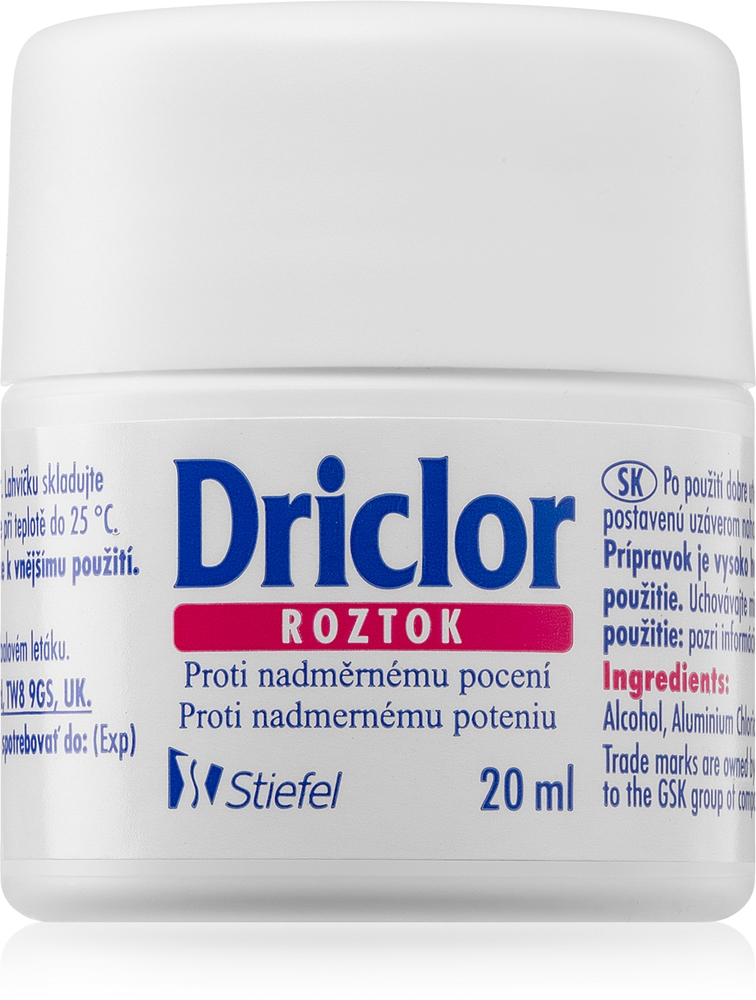
Driclor is a British clinical-strength antiperspirant sold as a single roll-on product and aimed at people with hyperhidrosis, the medical term for excessive sweating. Its active ingredient is aluminium chloride hexahydrate at 20%, and according to Wikipedia the product is manufactured by Stiefel Laboratories (UK) and produced in Sligo, Ireland [3]. The brand is no longer independently owned: through a chain of corporate deals its trademark now sits with Haleon, the consumer-healthcare company that demerged from GSK in 2022 [1][5].
Unlike a conventional deodorant, Driclor is positioned as a targeted treatment rather than a daily cosmetic. The company describes it as a roll-on "specially developed to help prevent excessive sweating" of the underarms, hands and feet, and its tagline promises an "effect lasting days, not hours". The product is sold through pharmacies rather than general retail.
Origin
Driclor's exact founding year is not documented in any primary source, and it is left open rather than inferred. What is established is that the antiperspirant was made by Stiefel Laboratories, a long-running dermatology company whose origins trace back to the J.D. Stiefel Company, established in Germany in 1847 [4]. Stiefel built its later business around medicated skincare, and Driclor became part of its UK output, with production based in Sligo, Ireland.
The brand's country of origin is itself layered. Wikipedia attributes the product to Stiefel Laboratories (UK) while recording manufacture in Sligo, Ireland; the United Kingdom is the brand's origin through the Stiefel UK subsidiary, and Ireland is the production location rather than the brand's home market.
Ownership
Driclor reached its present owner through two corporate moves rather than a direct sale of the brand itself. In July 2009, Stiefel Laboratories was acquired by GSK (GlaxoSmithKline) for 2.9 billion US dollars, bringing Stiefel's products under the pharmaceutical group [4]. In 2022, GSK separated its consumer-healthcare division into a newly listed company, Haleon, established on 18 July 2022 [5]. Driclor's trademark moved with that consumer business.
Ownership of Driclor is recorded inconsistently across sources. The brand's own Turkish site, operated by Haleon, carries Haleon copyright and a current Haleon Turkey regulatory code, identifying Haleon as the trademark holder [1]. Several UK pharmacy retailers, however, still list the manufacturer as GlaxoSmithKline [8] — listings that predate or have not been updated for the 2022 demerger. Notably, Driclor does not appear in the brand portfolios that Wikipedia records for either Stiefel or Haleon, so the ownership trail rests on the manufacturer statement and the brand site rather than a parent-company brand list.
Products
Driclor is sold as one product in roll-on form, offered in 20 ml and 75 ml bottles. Its single active ingredient is aluminium chloride hexahydrate at 20% [3]. The brand and pharmacy sources describe a mechanism in which the aluminium salt enters the sweat-gland ducts and forms a thick gel that plugs them, reducing and eventually stopping the flow of sweat in the treated area.
Usage instructions reflect its clinical positioning: it is applied to clean, dry skin at bedtime, used every one to two days at first and then tapered to roughly twice weekly once it takes effect. Documented side effects include itching, stinging, redness and irritation.
Positioning
Driclor frames itself around medical-grade efficacy rather than fragrance or everyday freshening. It is classified as a "pharmacy only" product, meaning it can be bought without a prescription but must be dispensed through a pharmacy [7]. That places it in a different category from mass-market antiperspirants and aligns with its audience: people who have tried standard products without success and are seeking a stronger, treatment-led option.
Recognition
Driclor has had a notable consumer-culture moment driven by social media. An editorial summary of a GQ Magazine article reports that the #Driclor hashtag on TikTok had accumulated nearly 16 million views, with one user describing the product as a "last resort" after lifelong hyperhidrosis, and the coverage framed it as a wellness trend comparable to dry brushing and face icing; the same source states the product can "apparently reduce sweating by up to 65 per cent" [6] — figures attributed to the editorial coverage rather than independently verified here.
Current status
Driclor is an active, currently marketed brand, though it is no longer an independent company; it is owned by Haleon following the Stiefel and GSK transactions described above. The most recent visible activity is its Haleon-operated marketing site, which carries a 2024 copyright and a live Haleon Turkey regulatory code, and the product remains stocked through pharmacy channels across several markets including the United Kingdom, Ireland and Turkey [1].
Facts & evidence
Documented facts from Glowpedia's fact base — every row carries a source.
Timeline#
Stiefel Laboratories (Driclor's manufacturer) acquired by GSK plc for $2.9 billion↗ en.wikipedia.org
Stiefel Laboratories acquired by GSK plc↗ en.wikipedia.org
GSK consumer healthcare division spun off into Haleon (18 July 2022); Driclor moves under Haleon umbrella↗ en.wikipedia.org
Spun off from GSK into Haleon (Haleon established 18 July 2022)↗ en.wikipedia.org
Signature products#
Driclor is sold only as a roll-on application bottle. Two package options are available: a 20ml roll-on and a 75ml roll-on.↗ en.wikipedia.org
Driclor Antiperspirant Roll-On — #Driclor hashtag on TikTok has nearly 16 million views; described by users as 'last resort' for lifelong hyperhidrosis sufferers↗ amaesthetics.clinic
Key ingredients#
Mentioned in#
GQ Magazine (summarized via AM Aesthetics) — Article on hyperhidrosis sufferers using Driclor; framed Driclor as wellness trend with #Driclor TikTok hashtag at nearly 16 million views↗ amaesthetics.clinic
Where to buy
Where the brand is sold according to Glowjakt's price data, per market.
Prices come from Glowjakt and are updated daily. Glowpedia receives no payment for clicks.
Ingredients across the range
Key ingredients across Driclor's range, from the ingredient lists of 1 of 1 products in Sweden.
Share of products with a known ingredient list. “None identified” means nothing matched our ingredient groups, not that the product is free of them.
Related brands

Sources
T1 primary · T2 secondary · T3 note- [1]T1driclor.com.trdriclor.com.tr (brand site)
- [3]T3en.wikipedia.org/wiki/DriclorWikipedia
- [4]T3en.wikipedia.org/wiki/Stiefel_LaboratoriesWikipedia
- [5]T3en.wikipedia.org/wiki/HaleonWikipedia
- [6]T3amaesthetics.clinic/blog/sweaty-guys-are-using-driclor-antiperspirant-everyday-but-does-it-actually-work-gq-magazine/amaesthetics.clinic
- [7]T4prescriptiondoctor.com/excessive-sweating/driclorprescriptiondoctor.com
- [8]T4theindependentpharmacy.co.uk/excessive-sweating/driclortheindependentpharmacy.co.uk