Overview
Dyson is a technology company founded in England in 1991 by the engineer James Dyson [5]. Although it is best known for bagless vacuum cleaners, bladeless fans and air purifiers, the company entered the beauty world in 2016 with the Supersonic hair dryer and has since built a compact but influential hair-care range — the Airwrap multi-styler, the Corrale straightener, the Airstrait styler and the Amino scalp treatment — that places it among the most recognisable names in premium styling tools.
The company remains privately held by James Dyson and his family, who own it outright, and it continues to operate at large scale, reporting revenue of £6.13 billion for 2025. Its hair-care line is presented not as cosmetics but as engineering-led devices.
Origin & founders
The story Dyson tells of itself begins with frustration rather than beauty. In the 1970s James Dyson bought a Hoover vacuum that lost suction, and on taking it apart he found dust clogging the mesh inside the bag. While working on an unrelated project he noticed how industrial cyclone systems separated particles from air, and reasoned the same principle could work in a home appliance. He built a cardboard prototype connected to his own bag-less Hoover and confirmed the idea worked. By the company's account, he then developed 5,127 prototype designs between 1979 and 1984 before arriving at a machine he was satisfied with [5].
The business was incorporated in 1991 in Malmesbury, Wiltshire, registered first as Barleta Limited and trading as Dyson Appliances Limited; the name was shortened to Dyson Ltd. in 2001. Its first mass-market product, the DC01 dual-cyclone bagless vacuum, reached shops in 1993 and, according to the company, became the best-selling vacuum cleaner in the United Kingdom within eighteen months. That engineering origin — a single overlooked problem solved through relentless iteration — remains the lens through which Dyson frames everything it later made, including its hair tools.
History & milestones
Dyson spent its first two decades expanding within home appliances, adding the Air Multiplier bladeless fan and the Airblade hand dryer in 2009. Its move into hair care came in 2016 with the Supersonic hair dryer, launched at £330 [6]. The price was unusual for the category, and early coverage centred as much on whether such a device could justify its cost as on the device itself.
Two further products defined the range. In 2018 the company launched the Airwrap multi-styler in New York, a tool built around the Coanda effect — the tendency of a jet of air to follow an adjacent surface, which Dyson uses to wrap and shape hair around a barrel using airflow rather than extreme heat [8]. In 2020 it released the Corrale, a cordless straightener and, by the company's description, the first Dyson hair tool to abandon airflow technology in favour of conventional heated plates, priced at around $500 [9]. The range has since grown to include the Airstrait styler and the Amino leave-in scalp treatment.
A defining corporate event fell between those launches. On 22 January 2019 Dyson announced it would move its global headquarters from the United Kingdom to Singapore, citing a wish to be closer to its fastest-growing Asia-Pacific markets [5]. The relocation, completed by the end of 2021, sits behind one of the few genuinely contested points about the company's identity (see Ownership).
Ownership
Dyson is independent and privately owned: James Dyson and the Dyson family hold 100 percent of the company [5]. It has no parent group and no portfolio of sister beauty brands.
Where sources diverge is on the company's home. Wikipedia records the current headquarters as the St James Power Station in Singapore, the company's base since the 2019–2021 relocation [5]. Dyson's own corporate material continues to emphasise its British roots and Wiltshire campuses at Malmesbury and Hullavington [2]. Both are accurate to different facts: the company was founded and historically based in Malmesbury, England, which remains its country of origin, while its global headquarters has been in Singapore since the move was completed.
Beyond corporate relocation, Dyson's acquisition history is modest. Its most notable purchase was the US solid-state battery start-up Sakti3, in which it took a full stake in October 2015 for $90 million [5] — a bet on battery technology rather than on cosmetics, and one later complicated when Dyson abandoned the related patents in 2017.
Philosophy & positioning
Dyson presents itself as an engineering company first, and its hair-care marketing leans on that identity rather than on conventional beauty language. The company describes its approach to hair tools as "no guesses, no gimmicks. Just proven and tested science." Efficiency is the stated core value — "it's in our DNA," as its corporate-responsibility material puts it — traced directly back to the original vacuum bag and to James Dyson's stated ambition, which he frames as the wish "to have an idea to make something better and carry it through, even if it seems impossible" [2].
For hair specifically, the positioning is consistent: faster drying, more controlled styling and, above all, results achieved "without heat damage." The audience the company addresses is one seeking professional-grade results, and its pricing sits firmly in the luxury tier of the category.
Products & innovation
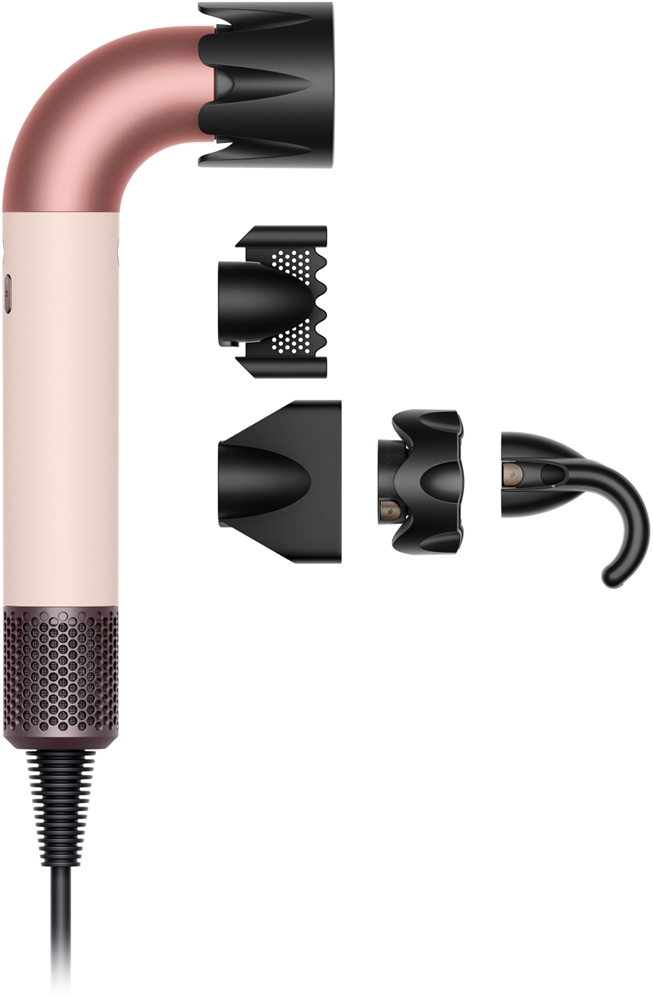
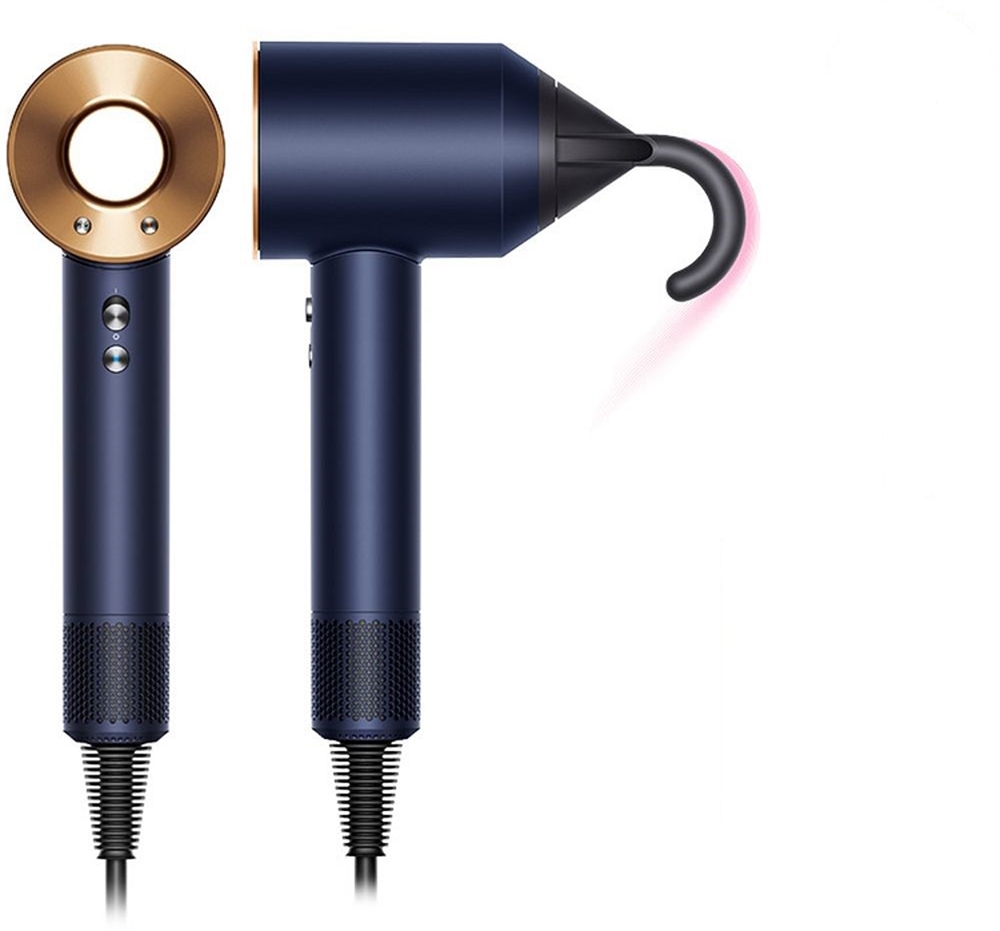
Dyson's hair range is small but distinct, and each product is built around a piece of proprietary engineering rather than a formulation. The Supersonic hair dryer is powered by the Dyson V9 digital motor, which the company says spins at up to 110,000 rpm; paired with its Air Multiplier technology, the motor produces a high-pressure jet of air, and is housed in the handle rather than the head to make the dryer lighter to hold. Dyson also describes an intelligent heat-control system that measures air temperature many times a second to regulate it and limit heat damage.
The Airwrap applies the Coanda effect to curl, wave and smooth hair using airflow, while the Corrale uses heated plates and cordless operation. Across the line, the recurring claim is the avoidance of extreme heat. The company cites measured benefits for its drying technology — that it can "increase smoothness by 75 percent, increase shine by up to 132 percent and decrease frizz and flyaways by up to 61 percent" through controlled drying [7] — figures presented as the company's own performance claims rather than independent findings.
The wider business underpins these tools with substantial research investment, including the Dyson Institute of Engineering and Technology, an in-house higher-education programme run in partnership with the University of Warwick that admitted its first students in 2017.
Recognition
Dyson's hair tools have drawn sustained beauty-press attention. Who What Wear and The Hollywood Reporter have both reviewed the Supersonic line, the latter framing the lower-priced Supersonic Origin as an accessible entry point to Dyson's hair-care range. Reviewers have repeatedly noted the line's premium reputation, and the Airwrap in particular is frequently described as one of Dyson's most sought-after hair tools.
The company has also tied the range to professional and celebrity credibility, naming the Hollywood hairstylists Jen Atkin, Matthew Collins and Irinel de Leon as partners, and in 2026 appointing the actor Park Bo-gum and the singer Jang Won-young as its Asia-Pacific ambassadors.
Sustainability
Dyson frames sustainability, like its products, in engineering terms — doing "more with less." The company says 82 percent of its facilities and 100 percent of its direct manufacturing run on renewable energy [4], and it points to early use of recycled plastic in its products from the mid-1990s and to long-life filters intended to reduce disposable waste. Its own material notes no third-party environmental certification and no published net-zero target date.
Controversies
Two episodes stand out in the company's public record. In February 2022, Channel 4 News reported allegations of forced-labour conditions at ATA IMS, a Malaysian contract manufacturer used by Dyson; the company subsequently terminated its contracts with the supplier [5]. Separately, in 2019 Dyson scrapped its electric-vehicle programme after significant investment, stating that the project was not commercially viable. Neither concerns the hair-care line directly, but both bear on the wider company that produces it.
Current status
Dyson is active and operating at global scale. It reported revenue of £6.13 billion for 2025, and its most recent visible activity includes the 2026 appointment of new Asia-Pacific brand ambassadors [5].
Facts & evidence
Documented facts from Glowpedia's fact base — every row carries a source.
Timeline#
Company founded by James Dyson in Malmesbury, Wiltshire, England (registered as Barleta Limited)↗ en.wikipedia.org
DC01 dual-cyclone bagless vacuum reaches market; became biggest-selling vacuum in the UK within 18 months↗ en.wikipedia.org
Acquired US solid-state battery start-up Sakti3 (full stake acquired Oct 2015 for $90 million)↗ en.wikipedia.org
Dyson Supersonic hair dryer launched (£330) — Dyson's entry into hair care↗ whowhatwear.com
Dyson Airwrap multi-styler launched (10 October 2018, New York), using the Coanda effect↗ dyson.com
Announced relocation of global headquarters from the UK to Singapore↗ en.wikipedia.org
Dyson Corrale cordless straightener launched (~$500) — first Dyson hair tool not based on air technology↗ whowhatwear.com
Signature products#
The Dyson Supersonic Hair Dryer launched in 2016 at £330.↗ whowhatwear.com
The Dyson Airwrap was launched on October 10, 2018, in New York. It's a multi-use tool that ... utiliz[es] an air-flow Coanda effect for bouncy curls.↗ dyson.com
The Corrale is the first Dyson hair tool to ditch the air technology in order to produce a heat-reliant hair straightener that costs $500.↗ whowhatwear.com
Dyson Airstrait™ styler↗ dyson.se
Dyson Airwrap — Repeatedly cited as one of Dyson's most popular and sought-after hair tools↗ whowhatwear.com
Proprietary technologies & patents#
“equipped with Dyson's V9 digital motor, which spins at up to 110,000rpm and combined with Air Multiplier technology, produces a high-pressure, high-velocity jet of controlled air”
Mentioned in#
Who What Wear — Beauty-editor review of the Dyson Supersonic; notes its premium reputation and 'glowing reviews' in the hair-tool category↗ whowhatwear.com
The Hollywood Reporter — Review of the Dyson Supersonic Origin; positions it as accessible entry to Dyson's premium hair-care line↗ hollywoodreporter.com
Certification pass
What each certification and self-stated claim rests on: the source, whose website it's on, and what needs review.
“Recycled Materials (DC02, 1995): Early adoption of recycled plastic in products”↗ dyson.se
None of these statements has been checked against the certifying bodies' registers. The statements were observed on 19 Jun 2026.
Where to buy
Where the brand is sold according to Glowjakt's price data, per market.
Prices come from Glowjakt and are updated daily. Glowpedia receives no payment for clicks.
Ingredients across the range
Key ingredients across Dyson's range, from the ingredient lists of 13 of 91 products in Sweden.
Share of products with a known ingredient list. “None identified” means nothing matched our ingredient groups, not that the product is free of them.
Sources
T1 primary · T2 secondary · T3 note- [2]T1dyson.se/om-dyson/socialt-foretagsansvar/vart-dnadyson.se (brand site)
- [4]T2dyson.se/om-dyson/hallbarhetdyson.se (brand site)
- [5]T3en.wikipedia.org/wiki/Dyson_(company)Wikipedia
- [6]T3whowhatwear.com/dyson-supersonic-hair-dryerwhowhatwear.com
- [7]T3hollywoodreporter.com/lifestyle/shopping/dyson-supersonic-origin-hair-styler-review-pricing-1235567409/hollywoodreporter.com
- [8]T3dyson.com/discover/innovation/new-machines/new-dyson-airwrap-multistylerdyson.com
- [9]T3whowhatwear.com/dyson-corrale-hair-straightenerwhowhatwear.com