
Overview
Veet is a brand of chemical hair-removal (depilatory) products with Canadian origins, now owned by the British-Dutch consumer-goods company Reckitt Benckiser [4]. Its creams, lotions, gels, mousses and wax strips are sold in more than 80 countries, and Reckitt lists Veet among its consumer "powerbrands" alongside names such as Lysol and Durex.
The product line traces back to a depilatory first registered in Canada in 1919 under the name Neet [5]. The "Veet" name came later, and for decades the same product carried different names in different markets — a history reflected in the brand's own reference to "a 100 year old journey" of hair-removal products.
Origin and early names
The depilatory that became Veet began as Neet, a product of the Hannibal Pharmaceutical Company, with the trademark registered in Canada in 1918 and the product first registered in 1919 [4][5]. A vintage-history account places its beginnings as "1919 in Canada, and 1922 in the US," and notes that the product "capitalized on the growing trend of hair removal, which in the 1920s was a new and popular way" of moving away from Victorian norms [6].
The name "Veet" was first used in the United Kingdom in 1922, derived from the French word vite, meaning "quickly." For a long time the two names ran in parallel: the product was sold as Veet in European markets such as France, while remaining branded as Neet in Canada and the United States until 2002, when the Veet name was adopted commercially in North America [4]. The brand has also gone by Immac historically.
Sources give slightly different founding dates depending on what is being counted. The underlying depilatory dates to 1919 (as Neet), while the "Veet" name itself was not coined until 1922. Reckitt's description of a roughly century-long heritage is consistent with the earlier 1919 inception.
Ownership
The trademark passed through several hands over the twentieth century. In 1958 it was transferred to the American Home Products Corporation, and in 1990 it was acquired by Reckitt Benckiser, which remains the brand's owner [4]. Reckitt is described as a British-Dutch company, and Veet sits within its wider portfolio of hygiene and health brands.
Products and how they work
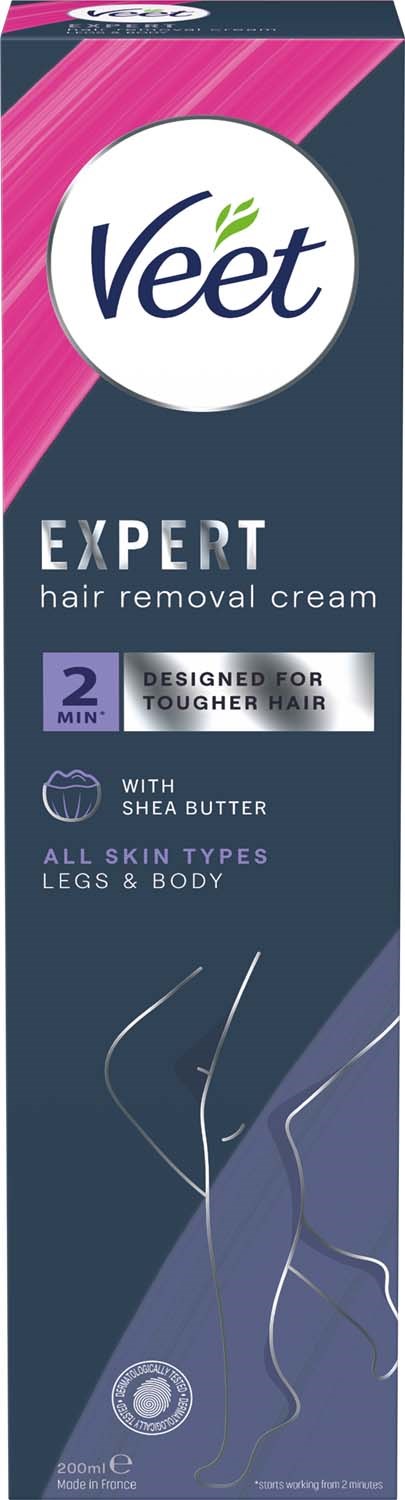
Veet produces hair-removal creams, lotions, gels, mousses and wax products, with variants formulated for normal, dry and sensitive skin, plus lines such as Naturals and Nikhaar. A widely marketed item is the Veet 2 Minute Hair Removal Cream, which the company says works on arms, underarms, legs and bikini areas with up to 48 hours of skin hydration.
The creams work chemically rather than by cutting the hair. According to the company, they contain thioglycolic acid and potassium hydroxide, which react to form potassium thioglycolate; this compound breaks the disulfide bonds in the hair's keratin, weakening the hair enough for it to be wiped away [4]. In more recent years the range has extended to devices, including a trimming tool called Sensitive Precision introduced around 2021.
Positioning
Veet frames hair removal as a matter of personal choice. The company describes its purpose as helping people "take care of their body hair the way you want and move confidently through life" through easy-to-use at-home products, and its brand pages carry lines such as "Your body, your choice!" and "Remove hair your way." Reckitt's brand page states that Veet offers "a range of superior hair-removal solutions to suit different skin types, styles and moods."
The brand's stated market position varies by scope: one Reckitt page calls Veet the "No. 1 depilatory brand worldwide" [2], while its US brand page describes it as the "No. 2 Depilatory brand in the US" [1] — a global claim alongside a US-specific ranking rather than a contradiction.
Controversies
Veet's advertising has drawn criticism on more than one occasion. In 2011 a French promotional test website faced complaints over messaging seen as potentially offensive. In April 2014 a set of commercials was criticised on social media for depicting unshaven women as masculine, which was described as an unkind portrayal [4].
Current status
Veet is an active, globally distributed brand. Reckitt lists it as a current powerbrand sold in more than 80 countries, and the range has continued to expand, with device products documented as recently as 2021 [1].
Facts & evidence
Documented facts from Glowpedia's fact base — every row carries a source.
Timeline#
Hannibal Pharmaceutical Company registers 'Neet' as a trademark in Canada↗ en.wikipedia.org
Hair removal product first registered in Canada under the name Neet↗ 1000logos.net
US trademark granted; 'Veet' name first used in the UK (from French 'vite' = quickly)↗ en.wikipedia.org
Trademark transferred to American Home Products Corporation↗ en.wikipedia.org
Reckitt Benckiser acquired the Veet trademark↗ en.wikipedia.org
Acquired by Reckitt Benckiser↗ en.wikipedia.org
'Veet' name first used commercially in Canada and the US (replacing 'Neet')↗ en.wikipedia.org
Product expansion to specialized devices such as 'Sensitive Precision'↗ en.wikipedia.org
Signature products#
their 'Veet 2 Minute Hair Removal Cream' works on arms, underarms, legs, and bikini areas with up to 48 hours skin hydration↗ reckitt.com
selling a device called 'Sensitive Precision' to style face, bikini and underarm↗ en.wikipedia.org
Key ingredients#
Where to buy
Where the brand is sold according to Glowjakt's price data, per market.
Prices come from Glowjakt and are updated daily. Glowpedia receives no payment for clicks.
Ingredients across the range
Key ingredients across Veet's range, from the ingredient lists of 41 of 55 products in Sweden.
Share of products with a known ingredient list. “None identified” means nothing matched our ingredient groups, not that the product is free of them.
Related brands

Sources
T1 primary · T2 secondary · T3 note- [1]T1reckitt.com/us/our-brands/veet/reckitt.com (brand site)
- [2]T2reckitt.com/brands/veet/reckitt.com (brand site)
- [4]T3en.wikipedia.org/wiki/VeetWikipedia
- [5]T41000logos.net/veet-logo/1000logos.net
- [6]T4blueridgevintage.wordpress.com/2014/02/22/1167/blueridgevintage.wordpress.com