
Overview
Crescina is a Swiss dermo-cosmetic hair brand specialising in topical treatments for hair thinning. It is owned by Labo International Srl, the company behind the Labo Suisse range, which was founded in Basel in 1986 [2]. Crescina's central idea is a distinction it returns to repeatedly: that hair thinning and outright hair loss are not the same problem, and that thinning — where the scalp begins to show through — calls for a different kind of treatment.
The brand's own dating is not entirely consistent. Labo Suisse's anniversary page places Crescina's origin in 1991, when its researchers first combined the molecules that would carry the name, with a Swiss trademark registered the following year [6]. The brand page, however, carries the tagline "Innovating Since 1998" [1] — a date that refers to the first Re-Growth formula rather than the brand's inception. The line remains actively sold today through Labo's distributor network and e-commerce.
Origin and history
According to the company, Crescina grew out of work by specialists focused on gradual hair thinning, who set out to build concentrations of active ingredients matched to different stages of the problem [7]. The first molecule combination was created in 1991 and registered as a Swiss trademark in 1992 [6].
The brand's history is told largely through successive formulas, each presented with a reported success rate among test subjects. The 1998 Re-Growth formula is cited at a 53% success rate; a 2009 "Stem" formula at 78%; and the 2012 HFSC formula at 100% of tested subjects [6]. A further Transdermal Technology patent was introduced in 2023. Labo Suisse has marked the line's 25-year anniversary.
Ownership
Crescina is one of several brands held by Labo International Srl, which trades as Labo Suisse [1]. The parent company describes itself as a premium dermo-cosmetic business with operations split between Swiss and Italian entities and headquarters in Basel. Its portfolio includes Fillerina, Collagenina, Rinfoltina and the sister hair line Cadu-Crex, among others. The company says it reaches consumers through a network of exclusive distributors across 44 countries [2].
Philosophy and positioning
Crescina positions itself as a non-invasive alternative to more aggressive interventions, built on what the company calls patented, "innovative, alternative" formulations inspired by aesthetic medicine. The treatments are sold in single-dose vials and tailored by gender and by severity, with separate formulations for men and women keyed to the Hamilton–Norwood scale for men and the Ludwig–Savin scale for women. Labo frames its work around four stated principles: excellence, innovation, care and added value.
Products and innovation
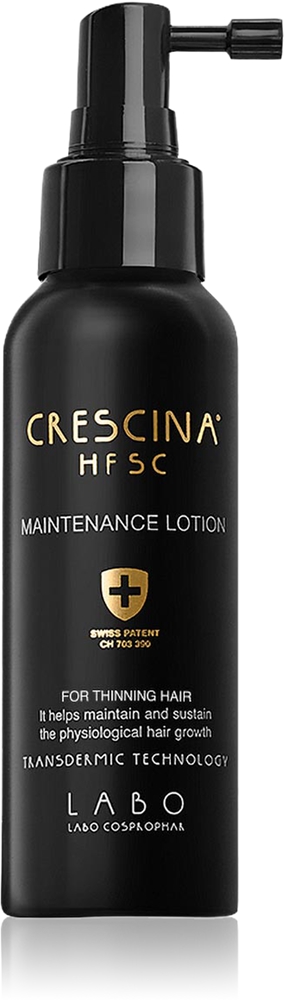
The line centres on the Crescina Transdermic HFSC range, which includes Re-Growth, a Complete Treatment, the Hair Follicular Islands variant and a shampoo. The Follicular Islands product targets clusters of grouped hair follicles, which the company says have higher energy needs than individual follicles and benefit from a dedicated formulation [5].
Underpinning the range is what Labo calls its Transdermic Technology, protected by Swiss Patent CH 711 466, which the company says lets active substances reach the scalp both through the follicle opening and through the skin layers, aided by their low molecular weight and added penetration enhancers. The formulas draw on a Re-Growth complex of the amino acids cysteine and lysine with a glycoprotein, and an HFSC complex using hydrolysed rice protein and corosolic acid [3]. Women's versions add biotin and Pueraria mirifica extract. The brand reports holding eight patents in total, covering both Swiss and European registrations [1].
Crescina's marketing leans heavily on clinical figures. The brand states its treatment is "effective in 100% of the subjects tested" after four months [3], and cites a double-blind, placebo-controlled study of 46 male volunteers showing improvement in all participants [1]. These efficacy claims are made by the manufacturer and are drawn in part from manufacturer-commissioned research.
That research does, however, extend to independent peer review. A 2013 study in the Springer journal Dermatology and Therapy, conducted by University of Pavia researchers, tested Crescina HFSC on 46 healthy men with androgenetic alopecia. It reported that 95.7% of subjects saw benefit at two months and 100% at four months, and concluded the treatment "was effective in stimulating hair follicle activity" [8].
Sustainability
Through its parent, Crescina is associated with the Labo Forest initiative, a reforestation project in the Peruvian Amazon run with the partner organisation zeroCO2 [4]. Labo Suisse, which announced the project in 2022, frames it as part of a broader sustainability effort that also includes reducing plastic in packaging and using recycled materials.
Current status
Crescina is an actively marketed line. It is sold through Labo Suisse's e-commerce site and its distributor network, with recent product and patent activity recorded as late as 2023.
Facts & evidence
Documented facts from Glowpedia's fact base — every row carries a source.
Timeline#
Labo researchers created the first combination of molecules (named Crescina)↗ labosuisse.com
Crescina Swiss trademark registered↗ labosuisse.com
Crescina Re-Growth formula developed (53% success rate in subjects)↗ labosuisse.com
Crescina Stem formula introduced (78% success rate among subjects)↗ labosuisse.com
Crescina HFSC launched (100% success rate in all tested subjects)↗ labosuisse.com
Signature products#
Crescina is a dermo-cosmetic treatment in vials designed to address hair thinning. The product "helps promote the physiological hair growth" and is "effective in 100% of the subjects tested."↗ labosuisse.com
Crescina Transdermic HFSC Hair Follicular Islands is a cosmetic treatment in vials for topical use.↗ labosuisse.com
Crescina Transdermic HFSC Complete Treatment↗ labosuisse.com
Crescina Transdermic HFSC Shampoo↗ labosuisse.com
Key ingredients#
Proprietary technologies & patents#
“Patented Transdermic Technology (Swiss Patent CH 711 466) facilitates deep penetration of active ingredients into scalp layers to promote natural hair growth.”
“8 patents total (Swiss and European) ... Swiss Patents: CH 689 821 A5, CH 693 814 A5, CH 693 815 A5, CH 703 390 B1, CH 704 629 B1, CH 697 229 B1, CH 693 816 A5 ... European Patent: EP 1 089 704 B1”
Mentioned in#
Dermatology and Therapy (Springer) — Peer-reviewed clinical study 'Clinical Efficacy of a Cosmetic Treatment by Crescina® Human Follicle Stem Cell on Healthy Males with Androgenetic Alopecia' by University of Pavia researchers.↗ pmc.ncbi.nlm.nih.gov
Certification pass
What each certification and self-stated claim rests on: the source, whose website it's on, and what needs review.
“Broader sustainability measures: "reduction of plastic materials in packaging, use of recycled materials”↗ labosuisse.com
None of these statements has been checked against the certifying bodies' registers. The statements were observed on 9 Jun 2026.
Where to buy
Where the brand is sold according to Glowjakt's price data, per market.
Prices come from Glowjakt and are updated daily. Glowpedia receives no payment for clicks.
Ingredients across the range
Key ingredients across Crescina's range, from the ingredient lists of 34 of 34 products in Sweden.
Share of products with a known ingredient list. “None identified” means nothing matched our ingredient groups, not that the product is free of them.
Sources
T1 primary · T2 secondary · T3 note- [1]T1labosuisse.com/en/brand-page/brand-crescina-en/labosuisse.com (brand site)
- [2]T1labosuisse.com/en/the-company/labosuisse.com (brand site)
- [3]T2labosuisse.com/en/product/crescina-transdermic-hfsc-re-growth/labosuisse.com (brand site)
- [4]T2labosuisse.com/en/labo-forest-labo-puts-down-roots-for-a-more-sustainable-future/labosuisse.com (brand site)
- [5]T2labosuisse.com/en/product/crescina-hair-follicular-islands/labosuisse.com (brand site)
- [6]T2labosuisse.com/en/crescina-anniversary/labosuisse.com (brand site)
- [7]T2labosuisse.com/en/brands/crescina/labosuisse.com (brand site)
- [8]T3pmc.ncbi.nlm.nih.gov/articles/PMC3680633/pmc.ncbi.nlm.nih.gov