Overview
Lierac is a French dermocosmetics brand founded in Paris in 1975 by Dr. Cariel, a physician specialising in aesthetic medicine [5]. From the outset it positioned its products as what the founder called true "beauty medicines" — skincare conceived with a medical mindset to address physiological concerns such as cellulite and stretch marks. The company has operated under a series of owners: it was acquired by the Alès Groupe in 1979 and, after that group entered administration, passed to the investment holding Impala SAS in 2020 [8]. Today it is run within Laboratoire Native, Impala's cosmetics division, alongside sister brands Phyto, Roger & Gallet and Jowaé [12].
Sold mainly through pharmacies and drugstores, Lierac sits in the prestige tier of the dermocosmetics market and is known internationally as a "French pharmacy" skincare brand focused on anti-ageing. The brand markets itself under the tagline "Cutting-edge dermocosmetics."
Origin & founders
According to the company, Dr. Cariel, a specialist in aesthetic medicine, became preoccupied with subjects such as cellulite and stretch marks, and in 1975 created Lierac with what it describes as an avant-garde approach: to offer genuine "beauty medicines" rather than superficial cosmetics [2]. An English-language account on the brand site frames the founder as "a doctor with a passion for the physiological concerns of women," and dates the company's three guiding pillars — science, femininity and excellence — to this beginning.
The brand states that it has maintained its own research and development laboratory since its founding, and that the laboratory remains central to how its formulas are developed.
History & milestones
Lierac's first product, Phytolastil, launched in 1975 as an anti-stretch-mark treatment and is presented by the company as the first product of its kind, developed in partnership with the Fondation du tissu conjonctif (a connective-tissue research foundation).
In 1979 the brand was bought by the group then known as Phytosolba Laboratories — later the Alès Groupe — which also owned the haircare brand Phyto. According to Wikipedia's account of the parent company, the L'Oréal group's purchase of 49% of the group's capital that year enabled the acquisition of Lierac, described as a "plant-based cosmetics brand" created four years earlier [8].
In July 2020, after the death of group founder Patrick Alès, the Alès Groupe entered administration [9]. On 24 September 2020 a commercial court approved the sale of the group's cosmetics division — including Lierac, Phyto and Jowaé — to Jacques Veyrat's holding company Impala for 13.5 million euros [11]. Trade press at the time reported that Impala intended to invest more than 100 million euros to relaunch innovation, and that the combined entity, including Roger & Gallet, carried a turnover of about 200 million euros, nearly 80% of it generated abroad.
Ownership
Ownership of Lierac has shifted over time, and sources differ on which parent to name depending on the period. The Alès Groupe owned the brand from 1979 until 2020; following the Impala takeover, Lierac has been operated under Laboratoire Native, the cosmetics group held by Impala SAS [12]. Impala SAS lists Lierac as one of four brands within Laboratoire Native, alongside Roger & Gallet, Phyto and Jowaé, and reports the group as employing around 600 people across 12 countries with close to 200 million euros in turnover.
Philosophy & positioning
Lierac describes its philosophy as a form of "sound naturalness" (in French, naturalité raisonnée) — balancing natural ingredients with synthetic actives chosen for their benefit to skin and environment. The company says its aim is less to mask problems than to "reprogram" the skin's mechanisms and teach it to function properly on its own. It states a mission of "speaking truthfully" in order to offer women long-term solutions across the stages of their lives.
The brand targets what its English-language materials call a "hedonistic, uninhibited and exacting" customer who expects both effectiveness and transparency about ageing and menopause. A 2012 editorial review characterised Lierac as a "French pharmacy brand" with "an air of seriousness, efficacy and mystery," aimed largely at women over 40 seeking anti-ageing care [10].
Products & innovation
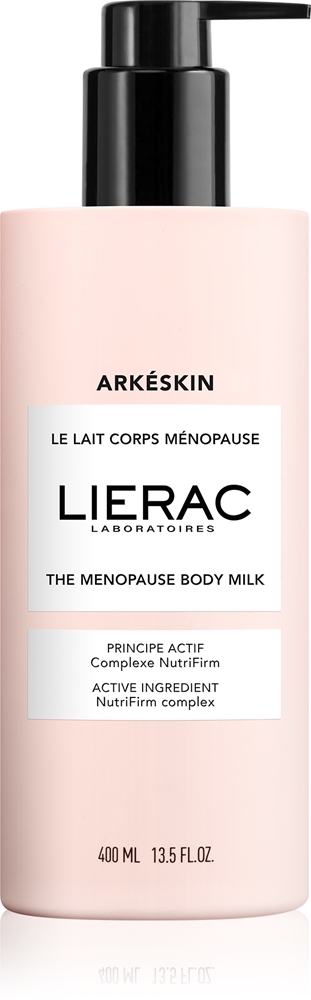
Lierac's range spans facial skincare and bodycare, with the facial line weighted toward anti-ageing. Recurring product lines include Premium (anti-ageing), Hydragenist (hydration), Lift Integral (firming), Sunissime (sun protection), the eye-care line Diopti, and Arkéskin, a range aimed at menopause. Phytolastil, the original 1975 launch, remains part of the bodycare line for stretch marks.
The company emphasises a laboratory-led, partnership-based approach to development. Its Premium line is described as inspired by regenerative medicine and created in partnership with Harvard University [6], and the brand says its actives are drawn from both medical and natural sources and encapsulated within formulas for stability. Lierac states that all of its products are tested under the control of independent dermatologists, and that the entire production process takes place in France, at a Parisian production site linked to its integrated research laboratories. Among its marketing claims, the brand says its Absolute Serum contains 7,300 micro-beads for anti-ageing benefit [6].
On sustainability, Lierac offers a line of eco-refills with recyclable refills for face care, and its parent group, Laboratoire Native, states that it is dedicated to offering responsible and environmentally friendly cosmetic products. The brand says its formulas avoid ingredients commonly singled out for avoidance, such as parabens, according to a third-party review [10].
Current status
Lierac is an active, multi-region brand that has changed hands twice. Since the 2020 Impala acquisition it has operated within Laboratoire Native, the cosmetics group owned by Impala SAS, and continues to maintain a current brand site and active product lines, including its Premium and Arkéskin ranges [12]. Its products are distributed chiefly through pharmacies and drugstores.
Facts & evidence
Documented facts from Glowpedia's fact base — every row carries a source.
Timeline#
Lierac founded by Dr. Cariel; Phytolastil (first anti-stretch mark product) launched the same year↗ en.lierac.com
Lierac acquired by the Alès Groupe (then Phytosolba Laboratories, owner of Phyto), enabled by L'Oréal purchasing 49% of the group's capital↗ en.wikipedia.org
Acquired by Alès Groupe (Phytosolba Laboratories / Phyto)↗ en.wikipedia.org
Alès Groupe's cosmetics division (incl. Lierac) sold to Impala (Jacques Veyrat) for €13.5 million after the group entered administration↗ en.wikipedia.org
Acquired by Impala SAS via takeover of Alès Groupe; now operated under Laboratoire Native↗ premiumbeautynews.com
Signature products#
PHYTOLASTIL - First anti-stretch mark product (launched 1975) developed "in partnership with the Fondation du tissu conjonctif"↗ en.lierac.com
PREMIUM line - "inspired by regenerative medicine and created in partnership with Harvard University"↗ en.lierac.com
Notable heritage products mentioned: Phytolastil, Diopti, Premium, Arkéskin↗ fr.lierac.com
Notable heritage products mentioned: Phytolastil, Diopti, Premium, Arkéskin↗ fr.lierac.com
Key Product Lines ... Sunissime (sun protection)↗ fr.lierac.com
Mentioned in#
Premium Beauty News — Reported Impala's takeover of the Alès group; described Lierac as 'premium anti-aging skincare' sold in pharmacies and drugstores↗ premiumbeautynews.com
Cosmetics Business — Reported that Alès Groupe, owner of beauty brands Phyto and Lierac, had entered administration↗ cosmeticsbusiness.com
Never Say Die Beauty — Editorial review describing Lierac as a 'French pharmacy brand' with 'an air of seriousness, efficacy and mystery'↗ neversaydiebeauty.com
Certification pass
What each certification and self-stated claim rests on: the source, whose website it's on, and what needs review.
“Nos Éco-Recharges" (Eco-Refills) product category mentioned in navigation ... References to recyclable refills for face care”↗ fr.lierac.com
“the whole production process for LIERAC skincare takes place in France”↗ en.lierac.com
“notably "don't use ingredients that we often try to avoid like parabens etc.”↗ neversaydiebeauty.com
None of these statements has been checked against the certifying bodies' registers. The statements were observed on 10 Jun 2026.
Where to buy
Where the brand is sold according to Glowjakt's price data, per market.
Prices come from Glowjakt and are updated daily. Glowpedia receives no payment for clicks.
Ingredients across the range
Key ingredients across Lierac's range, from the ingredient lists of 81 of 96 products in Sweden.
Share of products with a known ingredient list. “None identified” means nothing matched our ingredient groups, not that the product is free of them.
Related brands
Sources
T1 primary · T2 secondary · T3 note- [2]T2fr.lierac.com/cms/notre-histoirefr.lierac.com (brand site)
- [5]T2en.lierac.com/cms/our-historyen.lierac.com (brand site)
- [6]T2en.lierac.com/cms/skincare-researchen.lierac.com (brand site)
- [8]T3en.wikipedia.org/wiki/Ales_GroupeWikipedia
- [9]T3cosmeticsbusiness.com/phyto-and-lierac-beauty-brand-owner-al-s-groupe-enters-administration--167778cosmeticsbusiness.com
- [10]T3neversaydiebeauty.com/lierac-paris-skincare-review/neversaydiebeauty.com
- [11]T3premiumbeautynews.com/en/after-roger-gallet-impala-takes,17248premiumbeautynews.com
- [12]T3impala-sas.com/en/participation/laboratoire-native-2/impala-sas.com