
Overview
Weleda is a Swiss-German maker of natural cosmetics and anthroposophic medicines, founded in 1921 [2] and known for plant-based skincare, body care and hair care built on biodynamically grown ingredients. Its legal entity, Weleda AG, is headquartered in Arlesheim, Switzerland, while its main operational base and principal production site are in Schwäbisch Gmünd, Germany. The company grew out of the anthroposophy movement of the philosopher Rudolf Steiner and today operates in more than 50 countries, with subsidiaries in around 20 and a reported workforce of about 2,500.
More than a century after its founding, Weleda remains active and independent. It reported revenue of roughly €424 million in 2020 [9], continues to launch new products, and has drawn renewed attention through Skin Food, a rich moisturiser first sold in 1926 that found a fresh audience among make-up artists and younger consumers in the 2020s.
Origin and founders
Weleda emerged from the circle around Rudolf Steiner (1861–1925), an Austrian philosopher who founded anthroposophy, a spiritual movement that treats body, mind and spirit as parts of one connected whole. From the late 1910s, Steiner began working with doctors and chemists to shape a new approach to medicine grounded in that worldview. In 1921 he guided the physician Ita Wegman, the chemist Oskar Schmiedel and other medical professionals to establish Weleda, creating natural remedies intended to support the body's own capacity for self-healing.
The company credits three founders — Steiner, Wegman and Schmiedel [2] — though the record is slightly more layered. Wikipedia emphasises Steiner and Wegman as the founders of the earlier predecessor companies and describes Wegman as a Dutch gynaecologist rather than simply a physician [9]. The founding year is likewise not a single clean date. Weleda itself dates its origin to 1921, but in 1920 Steiner and Wegman had already established two predecessor firms, Futurum AG in Arlesheim, Switzerland, and Der Kommende Tag AG in Stuttgart, Germany. The name Weleda was not registered as a trademark until 1924, and the business was only officially incorporated as Weleda AG on 10 December 1928 [9].
The name itself reaches back much further: it derives from the German form of Veleda, a first-century Germanic seeress. Steiner designed both the company name and its logo, which is based on the Rod of Asclepius — a staff entwined with a snake, long a symbol of the medical and pharmaceutical professions. Steiner also sat on the company's advisory body and, in Weleda's telling, supplied its intellectual and spiritual foundations.
History and milestones
Commercial production began in 1921 in Schwäbisch Gmünd, on a former factory site that the predecessor company Der Kommende Tag AG had acquired in 1920; the same location remains Weleda's German headquarters today. In 1921 Ita Wegman also opened the clinic at Arlesheim, and the company laid out its first medicinal herb garden in 1922. Biodynamic farming — an organic method that treats the whole farm as a single living system — was developed by Steiner in 1924, and it remains central to how the company sources its plants.
The company's establishment coincided with Lebensreform, the "life reform" movement then current in Germany, which promoted alternative medicine and health food. Through the 1920s Weleda broadened its range, and several products introduced then — including skin food, arnica essence, rosemary bath, massage oil and toiletry milk, later iris milk — are recognisable in the catalogue still. Business grew quickly: the company's total turnover doubled between 1925 and 1928.
Weleda expanded abroad early. It founded the British Weleda Co. Ltd. in 1924, followed by subsidiaries in the Netherlands, the United States and Czechoslovakia in 1926, and then a long sequence of national companies through the twentieth century — Italy in 1953, New Zealand in 1955, Sweden in 1956, Japan in 1999 and Finland in 2004 among them. From 2018 the company also opened a series of City Spas in the Netherlands, Germany and elsewhere, extending the brand from products into treatment spaces.
The Nazi period tested the firm. During the 1930s parts of the Nazi Party regarded anthroposophy as hostile to National Socialism; the Anthroposophical Society was proscribed in 1935, and Weleda repeatedly faced the threat of a production ban that it managed to avoid only with considerable effort. Because its parent company was based in neutral Switzerland, Weleda came through the war comparatively intact.
More recent milestones cluster around sustainability and anniversaries. Weleda received the first-ever Union for Ethical BioTrade certification in 2018, marked its centenary in 2021 alongside a reforestation partnership with the charity treesisters, and earned B Corp certification the same year. In 2026 the company celebrated the 100th anniversary of Skin Food and staged a Weleda x Stella McCartney presentation at Paris Fashion Week.
Philosophy and positioning
Weleda's outlook is rooted in anthroposophy and what the company calls a holistic view of the human being. "We take a holistic view of the human being," its identity page states; "being healthy means the body, mind and spirit are in balance." That thinking runs through its stated mission — to nurture "the health and beauty of body, soul and spirit" in harmony with nature and people — and through six guiding principles the company sets out: holistic thinking, responsibility, trust, economic sustainability, open-mindedness and inspiration.
In practice, the positioning translates into certified natural cosmetics. Weleda says all of its cosmetic products are certified natural, free from mineral oil, parabens, silicones and PEGs, and free from synthetic fragrances, genetically modified ingredients and microplastic ingredients. It states that it does not test on animals and that more than 80 percent of the botanical raw materials it uses are certified organic. Priced in the mid-market range, Skin Food has been described in trade coverage as achieving, in the words of Weleda's UK managing director, "great value for [the] money" whose simple formulation "has created a cult following across generations."
Products and innovation
Weleda's catalogue spans face, body, hair, health, mother-and-baby and men's care. Its plant work centres on a set of "lead plants" — arnica, birch, calendula, iris, lavender and wild rose [9] — supplemented by ingredients such as pomegranate, argan oil, sea buckthorn and evening primrose.
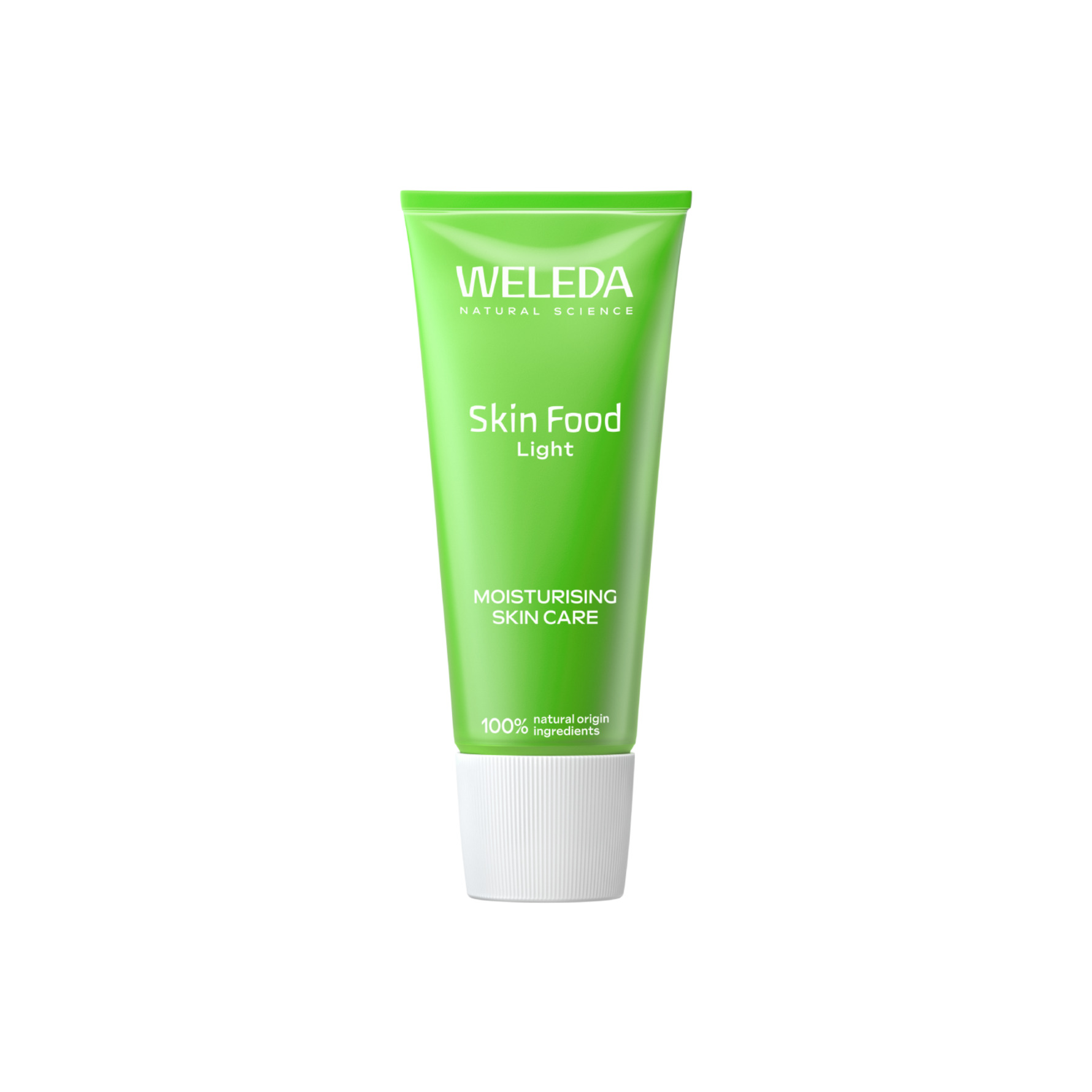
Three product families anchor the brand. The arnica range is positioned around recovery and is promoted through partnerships with athletes. The Calendula-based Mum & Baby line addresses pregnancy and infant care. But the single most recognised product is Skin Food, a thick herbal cream first sold in 1926 to soothe dry, damaged skin [10]. Its formula uses extracts of organic pansy, chamomile and calendula, and the company has pointedly resisted reformulating it. According to Weleda's UK managing director, Jayn Sterland, the original recipe "hasn't been changed because it simply works" — none of the usual reasons to reformulate, she argued, applied to it.
Skin Food's modern reach is unusual for a century-old product. From a single cream it has grown into a line of around 18 products, and Weleda has courted make-up artists since 2009 by placing it in their kits as a rich under-make-up primer; by Sterland's account, some 99 percent of make-up artists now carry a Skin Food product [10]. She has credited the arrival of high-definition television, which made skincare visible backstage, as a turning point in the product's fortunes. It has also attracted a long list of celebrity users: Victoria Beckham described it as her "body secret" in an interview, and coverage has named Adele, Rita Ora, Hailey Bieber, Priyanka Chopra, Julia Roberts and others among its fans [11].
That attention has translated into sharp growth on social media. According to figures reported by BeautyMatter, Skin Food drew 19.6 million impressions in 2024, up more than 200 percent on the year before, and 22.3 million views over the same period. The green tube has become a recurring presence at cultural events, from Paris Fashion Week to the RHS Chelsea Flower Show, and reviewers have pointed to strong ratings and tens of thousands of customer reviews online.
The company backs its products with a substantial research operation, employing more than 100 specialists in research and development. Its approach draws on anthroposophy and the idea of salutogenesis — activating the body's own powers of self-healing — and it studies plants closely to understand how they work; the firm describes examining the prickly pear to learn how it retains moisture before using it in a cream. Weleda collaborates with the research institute at the Goetheanum in Switzerland to investigate how plant properties relate to the human body and which species suit particular skin conditions.
On the pharmaceutical side, the company says nearly 300 clinical studies have been published on anthroposophic medicines. It cites the International Primary Care Outcomes Study, which compared conventional and anthroposophic treatment of acute respiratory and ear infections and, in Weleda's account, found anthroposophic-treated patients recovered more quickly, and it says its Gencydo hay-fever spray has "very good evidence for the effectiveness." Current research areas listed by the company range from sleep disorders and stress-related complaints to skin diseases, and it markets proprietary formulation work under the name "Weleda Swiss Natural Science."
Weleda's products carry several third-party certifications. All cosmetics bear the NATRUE seal, an international non-profit natural-cosmetics standard, and the group is a member of the Union for Ethical BioTrade. It has been a certified B Corporation since 2021, recertified in October 2024 with a score of 120.66 [5].
Sustainability
Sustainability sits at the centre of Weleda's public identity, and the company frames it as taking "only what we can give back — and ideally, to give even more." As a B Corp, it has written social and ecological aims into its statutes. It reports that 97 percent of its waste is recycled, that 95 percent of the electricity used across the Weleda Group comes from renewable sources, and that 80 percent of its plant-based raw materials are organically sourced. Its Cradle Campus logistics centre, built from wood and rammed earth and powered by geothermal and solar energy, is described by the company as operating without emissions.
Ethical sourcing is a related theme: Weleda maintains fair-trade partnerships with long-standing suppliers and cultivates plants across biodynamic gardens — eight worldwide, by its own count — intended to support healthy soils and local ecosystems. It has run packaging take-back schemes, partnering with TerraCycle so that customers can return empty Skin Food packaging to be recycled free of charge, and in 2019 it backed Borneo Orangutan Survival with a pledged donation. The company states a goal of becoming carbon neutral, and reports that its Benelux operation has been climate-neutral for several years.
Recognition
Much of the recognition Weleda has received is tied to sustainability. It won first prize in the categories "Sustainable Leadership" and "Sustainable Pioneer" at the 2021 Sustainable Beauty Awards, run by the analysts Ecovia Intelligence, and lists the German Sustainability Award, the Swiss Ethics Award and the Green Brands Award among its honours.
Skin Food has generated most of the brand's editorial attention in recent years. The trade publication BeautyMatter, in a 2026 feature marking the product's centenary, documented its rise from a "best-kept beauty secret" to a fixture of make-up kits and its rapid growth on TikTok and Instagram among younger consumers, describing it as an "anti-trend beauty icon" that stays relevant without chasing trends [10].
Controversies
Weleda's history and its philosophical basis have both drawn criticism. The most serious episode dates to 1943, when Weleda delivered a one-off consignment of frostbite protection cream to the German armed forces. The cream reached SS staff surgeon Sigmund Rascher, who conducted hypothermia experiments on prisoners at the Dachau concentration camp. In the 1990s Weleda distanced itself from these events and apologised to the Holocaust survivors' association Aktion Kinder des Holocaust [9].
The company has also faced scrutiny over Iscador, a fermented white-mistletoe extract that it has historically produced and marketed as an anti-tumour treatment. Widely used to treat cancers in Switzerland and Germany in the 1980s, the preparation has since had its ineffectiveness established, and its use is not recommended by the Swiss Cancer Congress or the Swiss cancer league [9]. More broadly, Weleda's products rest on anthroposophic medicine, which Wikipedia characterises as a pseudoscience.
Current status
Weleda remains an active, independent multinational more than a hundred years after its founding. It continues to release new products — recent launches include the Clear & Pure Skin Booster Serum Drops and a UV Glow Fluid — maintains active social channels, and pursued current partnerships through 2026, including the Skin Food centenary campaign and its collaboration with Stella McCartney at Paris Fashion Week. The company's precise ownership structure is not detailed in public sources, but it is incorporated as Weleda AG with its registered headquarters in Switzerland.
Facts & evidence
Documented facts from Glowpedia's fact base — every row carries a source.
Timeline#
Rudolf Steiner and Ita Wegman found predecessor companies Futurum AG (Arlesheim) and Der Kommende Tag AG (Stuttgart)↗ en.wikipedia.org
Der Kommende Tag AG acquired the former 'Colonial-Werke Paul Rumpus' in Schwäbisch Gmünd (now Weleda's German headquarters)↗ en.wikipedia.org
Weleda established; Ita Wegman opens the Arlesheim clinic; commercial production begins in Schwäbisch Gmünd↗ weleda.co.uk
First medicinal herb garden established↗ weleda.co.uk
Name 'Weleda' registered as a trademark; biodynamic farming developed by Rudolf Steiner; British Weleda Co. Ltd. founded↗ en.wikipedia.org
Skin Food launched↗ beautymatter.com
Company officially registered under the name Weleda AG (10 December 1928)↗ en.wikipedia.org
Swedish subsidiary founded↗ en.wikipedia.org
Finnish subsidiary founded↗ en.wikipedia.org
Received the first-ever UEBT ('Sourcing with Respect') certification↗ en.wikipedia.org
Company centenary (100 years); B Corp certification; treesisters reforestation partnership↗ en.wikipedia.org
B Corp recertified with score of 120.66 (October 2024)↗ weleda.co.uk
Skin Food 100th anniversary campaign; Weleda x Stella McCartney at Paris Fashion Week↗ weleda.co.uk
Awards#
Sustainable Beauty Awards (Ecovia Intelligence) — Sustainable Leadership & Sustainable Pioneer↗ en.wikipedia.org
German Sustainability Award↗ weleda.co.uk
Swiss Ethics Award↗ weleda.co.uk
Green Brands Award↗ weleda.co.uk
Signature products#
Weleda Skin Food has been caring for people's skin since 1926↗ weleda.co.uk
save ⅓ on award-winning arnica essentials↗ weleda.co.uk
MUM & BABY — Gentle care for every stage of motherhood, bump to baby.↗ weleda.co.uk
Skin Food — Cult classic across generations; reportedly ~99% of make-up artists carry a Skin Food product; strong Gen Z TikTok/Instagram growth; described as an 'anti-trend beauty icon'↗ beautymatter.com
Key ingredients#
Proprietary technologies & patents#
“Weleda Swiss Natural Science has harnessed and optimized these properties for skincare.”
Mentioned in#
BeautyMatter — Feature article 'How Weleda Skin Food Survived 100 Years' documenting Skin Food's cult status, makeup-artist advocacy and TikTok growth↗ beautymatter.com
Woman & Home — 'Weleda Skin Food is Victoria Beckham-approved' — celebrity-fan coverage↗ womanandhome.com
Certification pass
What each certification and self-stated claim rests on: the source, whose website it's on, and what needs review.
“B Corp Certified since 2021, recertified October 2024 with score of 120.66”↗ weleda.co.uk
“Weleda products bear the NATRUE seal, an international non-profit certification.”↗ weleda.co.uk
“Weleda Benelux has been climate-neutral for several years.”↗ en.wikipedia.org
“Weleda Group holds membership in the Union for Ethical Biotrade (UEBT).”↗ en.wikipedia.org
“becoming a carbon neutral company”↗ weleda.co.uk
“No animal testing”↗ weleda.co.uk
“Free from synthetic fragrances, genetically modified ingredients and microplastic ingredients”↗ weleda.co.uk
“Free from mineral oil, parabens, silicones and PEGs”↗ weleda.co.uk
“80% botanicals certified organic”↗ weleda.co.uk
“Free from mineral oil, parabens, silicones and PEGs”↗ weleda.co.uk
None of these statements has been checked against the certifying bodies' registers. The statements were observed on 18 Aug 2026.
Where to buy
Where the brand is sold according to Glowjakt's price data, per market.
Prices come from Glowjakt and are updated daily. Glowpedia receives no payment for clicks.
Ingredients across the range
Key ingredients across Weleda's range, from the ingredient lists of 320 of 341 products in Sweden.
Share of products with a known ingredient list. “None identified” means nothing matched our ingredient groups, not that the product is free of them.
Sources
T1 primary · T2 secondary · T3 note- [2]T1weleda.co.uk/weleda/our-story/heritageweleda.co.uk (brand site)
- [5]T2weleda.co.uk/weleda/our-responsibility/sustainabilityweleda.co.uk (brand site)
- [9]T3en.wikipedia.org/wiki/WeledaWikipedia
- [10]T3beautymatter.com/articles/how-weleda-skin-food-survived-100-yearsbeautymatter.com
- [11]T3womanandhome.com/beauty/beauty-news/weleda-skin-food-celebrity-fans/womanandhome.com