Overview
Kiehl's is an American skincare, haircare and body-care brand that began in 1851 as a single homeopathic apothecary in Manhattan's East Village, at the corner of Third Avenue and 13th Street [7]. For nearly 150 years it operated from that one New York store before L'Oréal acquired it in 2000 and expanded it into a global retail name. The brand still trades on its apothecary roots, signing itself "Kiehl's Since 1851" and presenting an old-pharmacy aesthetic of plain labels and ingredient-led formulas.
Today Kiehl's sits within L'Oréal's Luxe division and remains active worldwide, with hundreds of dedicated stores alongside department-store counters, airport locations and independent stockists. It is unusual among prestige skincare brands for the size of its male customer base, which the company's own history and outside accounts put at roughly a third or more of its clientele.
Origin & founders
The store was founded in 1851 by the pharmacist John Kiehl, who had bought an existing apothecary after training as an apprentice; his firm, John Kiehl & Co., first traded under the name "Kiehl Pharmacy." According to the brand, the original shop served customers at 13th Street and Third Avenue, mixing teas, herbs, tinctures, honeys and the first Kiehl-branded preparations on the premises.
Ownership passed through a single family line for generations. Irving Morse, a Russian émigré who had apprenticed under John Kiehl and earned a pharmacology degree from Columbia University, purchased the business in 1921 and built it into a full-service pharmacy. It was Irving Morse who, the company says, made "Try Before You Buy" the shop's unofficial motto — a practice of personalised service and free sampling that the brand still describes as a defining tradition [1].
History & milestones
Irving's son Aaron Morse took control in 1961 and reoriented the business away from pharmaceuticals toward natural hair and skin care [8]. Under his direction the store introduced several products that became long-running fixtures, among them Blue Astringent Herbal Lotion in 1964 and Musk Oil in 1969. Aaron Morse also formalised the free-sample policy and the deliberately simple packaging that came to define the brand's look.
Leadership stayed in the family when Aaron's daughter, Jami Morse Heidegger, assumed control in 1988, running the company with her husband Klaus Heidegger and growing annual sales toward roughly $40 million. By the late 1990s the single store was struggling to keep pace with rising demand. According to Wikipedia, L'Oréal had pursued the company for more than two years, and the difficulty of handling growing order volumes became the catalyst for a sale.
L'Oréal completed the acquisition in 2000, through its U.S. luxury subsidiary Cosmair Inc. Sources differ slightly on the details: Wikipedia records the deal as April 2000 at a reported $100 to $150 million, while the company-history reference Encyclopedia.com dates it to February 2000 and gives a range of $80 to $150 million [7][8]. The year itself is not in dispute. Under L'Oréal, sales are reported to have climbed from around $40 million at acquisition to about $200 million by 2009 and roughly $1 billion by 2016 [7]. In 2022 the brand refreshed its original flagship store under a campaign titled "We Skincare About You Since 1851."
Ownership
Kiehl's has been a wholly owned L'Oréal brand since 2000 and is positioned within the group's L'Oréal Luxe division, the prestige portfolio that also includes Lancôme, Giorgio Armani Beauty and Yves Saint Laurent [9]. In L'Oréal's own reporting, Kiehl's is named among the Luxe brands contributing to group sales, and trade press has cited it alongside Lancôme and YSL as a driver of recent results. Its L'Oréal stablemates also include Garnier, Maybelline, Vichy, Biotherm and Helena Rubinstein, among others.
Philosophy & positioning
Kiehl's positions itself as an apothecary brand built on science, naturally derived ingredients and personalised service, a framing it traces directly to its 1851 pharmacy origins. The company places its products at the lower end of prestige skincare and emphasises plain, functional packaging meant to echo the original apothecary [3].
Its marketing has long leaned on sampling and word of mouth rather than conventional advertising. Wikipedia reports that Kiehl's distributes more than 12 million product samples a year, which it describes as around 80 percent of the brand's total marketing budget. The same unorthodox approach is tied to one of the brand's more distinctive traits: an exceptionally large share of male customers, reported at 30 to 40 percent of its base and approaching half in cities such as New York and Los Angeles [7].
Products & innovation
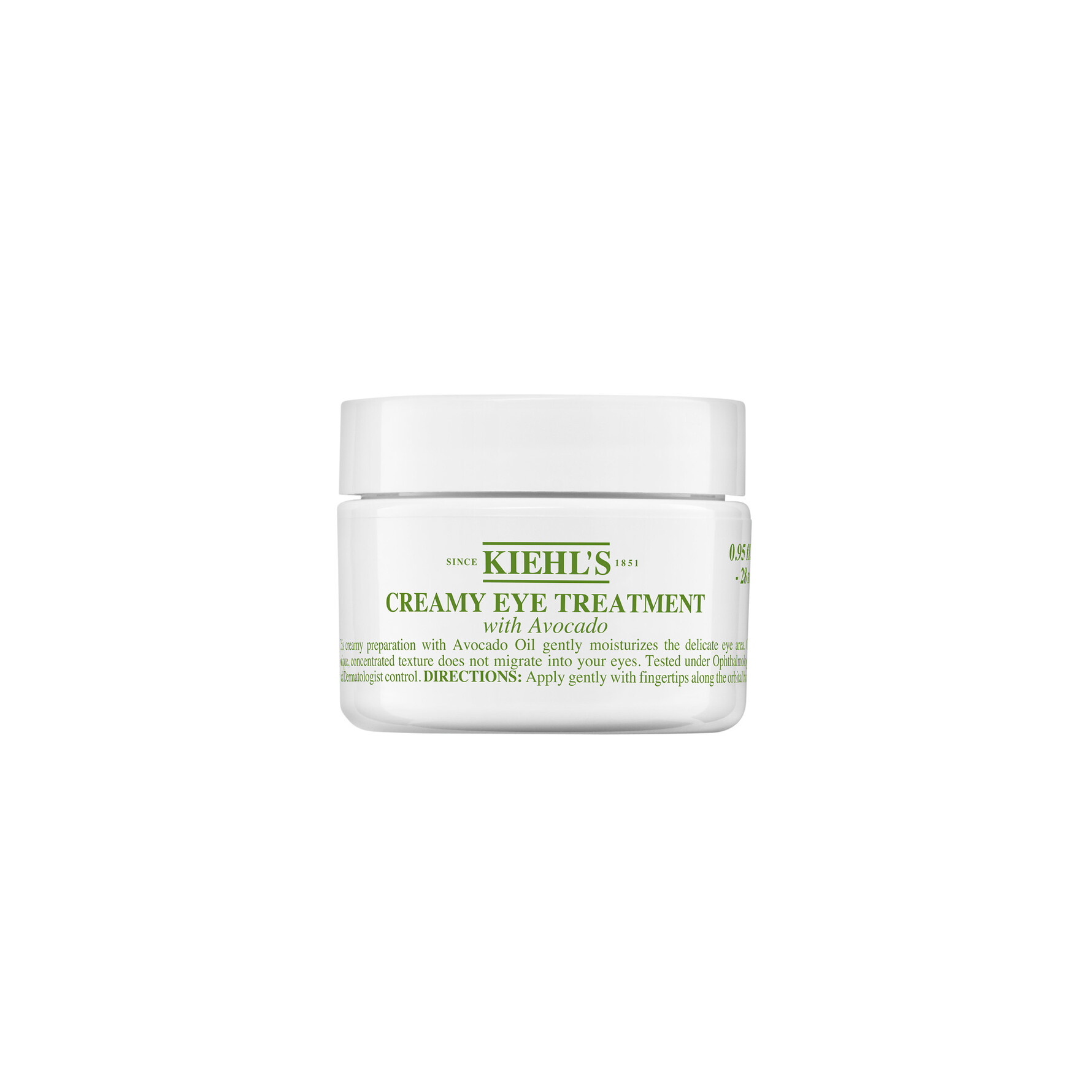
Several Kiehl's products have remained in the range for decades. The brand identifies Ultra Facial Cream as its top-selling moisturiser and a cult-favorite; it dates the original Ultra Facial Moisturizer to the early 1970s and says that early version is held in the collection of the Smithsonian [4]. Creme de Corps, a cocoa-butter body lotion, is described by the company as a best-seller of nearly 40 years' standing, while Midnight Recovery Concentrate, a facial oil, is presented as a more recent modern classic. Older signature items such as Blue Astringent Herbal Lotion and Musk Oil trace back to the 1960s.
Across its formulas the brand highlights ingredients including squalane, avocado oil, cocoa butter, shea butter and calendula. It states that all of its skincare and haircare products are made without parabens and that 98 percent of its formulas contain three or more renewable ingredients [6]. The company also makes specific performance claims for its hero products, saying, for example, that Ultra Facial Cream absorbs quickly and provides hydration for up to 24 hours.
Sustainability
Kiehl's frames its environmental work under a program it calls Mission Renewal, or "Journey to Circularity." The brand says more than 80 percent of its packaging uses recycled materials and that it has run an in-store recycling scheme for empty containers since 2009 [5]. It has also expanded refillable formats: according to the company, several staple products are now refillable, with a one-litre Creme de Corps refill pouch using 81 percent less plastic than conventional packaging. On the manufacturing side, the brand states that it has cut water waste by 78 percent and that its production facilities run entirely on renewable electricity.
Recognition
Kiehl's is regularly cited in business and trade coverage of L'Oréal's performance rather than for individual product awards. Cosmetics Business named it in 2024 among the brands lifting L'Oréal Group sales [10]. Its standing also rests partly on the longevity and following of products such as Ultra Facial Cream and Creme de Corps, both described as cult-favorite items in the brand's own product communications.
Controversies
The brand has faced criticism over its sourcing of squalane. As Wikipedia notes, Kiehl's has been the subject of allegations that the ingredient was derived from shark liver oil; the company states that its squalane is sourced from olives. In 2025 a Kiehl's advertising campaign titled "Pubic Display Type," promoting intimate-care products with imagery of visible pubic hair, drew censorship and public controversy [7].
Current status
Kiehl's is an active, globally operating brand. As of 2015 it reported 65 stores in the United States and around 400 worldwide, supported by more than 1,000 points of sale. More recent figures from L'Oréal's 2024 reporting indicate continued growth, with the brand opening 42 new locations globally that year, including 13 in China [9]. Its 2025 advertising activity further confirms ongoing operation. The brand is sold across the Nordic markets, where Kiehl's maintains country-specific storefronts.
Facts & evidence
Documented facts from Glowpedia's fact base — every row carries a source.
Timeline#
John Kiehl establishes a homeopathic apothecary at 3rd Avenue and East 13th Street, New York City.↗ en.wikipedia.org
Irving Morse, a former apprentice, purchases the store and expands it into a full-service pharmacy.↗ en.wikipedia.org
Aaron Morse takes control and shifts the business from pharmaceuticals to natural hair and skin care.↗ encyclopedia.com
Blue Astringent Herbal Lotion introduced.↗ encyclopedia.com
Musk Oil introduced.↗ encyclopedia.com
Jami Morse Heidegger (Aaron's daughter) assumes leadership of the company.↗ en.wikipedia.org
L'Oréal acquires Kiehl's for between $100–$150 million.↗ en.wikipedia.org
Acquired by L'Oréal (via U.S. luxury subsidiary Cosmair Inc.)↗ en.wikipedia.org
Signature products#
Ultra Facial Cream with Squalane is Kiehl's number-one best-selling moisturizer, and it's a cult-favorite ... When Kiehl's launched the first Ultra Facial Moisturizer in the early 1970s, it became a classic and is now part of the Smithsonian Museum's collection.↗ kiehls.com
Creme de Corps Body Lotion with Cocoa Butter first hit Kiehl's shelves nearly 40 years ago and has been a best-seller ever since.↗ kiehls.com
Midnight Recovery Concentrate is among Kiehl's well-known products, and Midnight Recovery became a modern classic.↗ kiehls.com
Notable products include Blue Astringent Herbal Lotion and Creme de Corps.↗ en.wikipedia.org
Introduced Blue Astringent (1964) and Musk Oil (1969)↗ encyclopedia.com
Ultra Facial Cream — Kiehl's number-one best-selling moisturizer and a cult-favorite; the original early-1970s Ultra Facial Moisturizer is in the Smithsonian Museum's collection.↗ kiehls.com
Creme de Corps — Body lotion that has been a best-seller for nearly 40 years; described as one of Kiehl's cult-favorite products.↗ kiehls.com
Midnight Recovery Concentrate — Described as a 'modern classic' among Kiehl's well-known products.↗ kiehls.com
Key ingredients#
Mentioned in#
Cosmetics Business — Cited among brands (Lancôme, YSL, Kiehl's) boosting L'Oréal Group's sales.↗ cosmeticsbusiness.com
Certification pass
What each certification and self-stated claim rests on: the source, whose website it's on, and what needs review.
“All Kiehl's skin and haircare products are formulated without parabens, and a full 98% of their formulas feature three or more renewable ingredients.”↗ kiehls.com
“More than 80% of Kiehl's packaging is made with recycled materials. Kiehl's utilizes only simple, efficient, recyclable packaging.”↗ kiehls.com
“Several Kiehl's must-haves, including the iconic Creme de Corps Body Lotion with Cocoa Butter, are now refillable, with each one-liter refill pouch using 81% less plastic than traditional packaging.”↗ kiehls.com
None of these statements has been checked against the certifying bodies' registers. The statements were observed on 12 Jun 2026.
Where to buy
Where the brand is sold according to Glowjakt's price data, per market.
Prices come from Glowjakt and are updated daily. Glowpedia receives no payment for clicks.
Ingredients across the range
Key ingredients across Kiehl's's range, from the ingredient lists of 217 of 250 products in Sweden.
Share of products with a known ingredient list. “None identified” means nothing matched our ingredient groups, not that the product is free of them.
Related brands

Sources
T1 primary · T2 secondary · T3 note- [1]T1kiehls.com/heritage.htmlkiehls.com (brand site)
- [3]T2kiehls.com/our-history/kiehls.com (brand site)
- [4]T2kiehls.com/skincare/best-selling-skincare-products/kiehls.com (brand site)
- [5]T2kiehls.com/mission-renewal.htmlkiehls.com (brand site)
- [6]T2kiehls.com/product-information.htmlkiehls.com (brand site)
- [7]T3en.wikipedia.org/wiki/Kiehl'sWikipedia
- [8]T4encyclopedia.com/books/politics-and-business-magazines/kiehls-1851-incencyclopedia.com
- [9]T3loreal-finance.com/en/annual-report-2024/luxe/loreal-finance.com
- [10]T3cosmeticsbusiness.com/lanc-me-ysl-and-kiehl-s-boost-l-or-al-group-s-sales--135653cosmeticsbusiness.com