Overview
Tiffany & Co. is an American luxury house founded in 1837, best known for fine jewelry but present in the beauty market through a licensed line of fragrances. It began in New York as a "fancy goods" store and grew into one of the defining names in American luxury. Since January 2021 it has been owned by the French group LVMH Moët Hennessy Louis Vuitton [3], and it remains an active business, operating more than 300 stores worldwide as of 2023. For beauty shoppers, the brand is represented by its perfumes rather than its jewelry.
Sources differ on the founding details. The company's owner records it as "founded in 1837 by Charles Lewis Tiffany in New York City" [1], while Wikipedia and Sotheby's add a co-founder, John B. Young, and note the original partnership was called "Tiffany, Young and Ellis" (later "Tiffany & Young") [3][4]. Wikipedia also places the founders' origin in Brooklyn, Connecticut, though the business itself is consistently tied to New York [3]. All sources agree on the founding year of 1837 and the American origin.
Origin & founders
According to Sotheby's, the venture opened in New York as a store selling "fancy goods," and its first day of trading brought in just $4.98 [4]. Its founder, Charles Lewis Tiffany, later earned the nickname "King of Diamonds," a reputation that helped establish the firm as a leader in American luxury through the late nineteenth century.
History & milestones
Several early developments shaped the house's identity. In 1878 it acquired a 278.42-carat rough yellow diamond, later cut into the 128.54-carat stone known as the Tiffany Diamond [4]. In 1886 it introduced the Tiffany Setting, a six-prong solitaire design that lifts the diamond above the band to let in more light. The distinctive robin's-egg blue used on its packaging was trademarked as "Tiffany Blue" in 1998 and later standardized with Pantone as "1837 Blue". The brand's wider cultural reach was cemented by the 1961 film Breakfast at Tiffany's, which, as Sotheby's notes, introduced it to a global audience beyond jewelry.
The company entered beauty relatively late. Its first fragrance, "Tiffany" for women, launched in 1987, followed by "Tiffany for Men" in 1989. After a long pause, it signed a fragrance licensing agreement with the beauty company Coty Inc. in January 2016, covering "development, production and distribution of a new line of Tiffany fragrances for both women and men" [2]. That partnership produced the 2017 Tiffany & Co. Eau de Parfum, described in one review as the company's "first major fragrance release in almost fifteen years" [5].
Ownership
Tiffany & Co. has changed hands twice in its modern history. It was acquired by Avon Products in 1978 for $104 million [3], and in January 2021 it was bought by LVMH Moët Hennessy Louis Vuitton for $15.8 billion, a transaction that delisted the company from the New York Stock Exchange [3]. Under LVMH it sits alongside beauty and luxury labels including Guerlain, Acqua di Parma, Benefit Cosmetics and Make Up For Ever.
Products & innovation
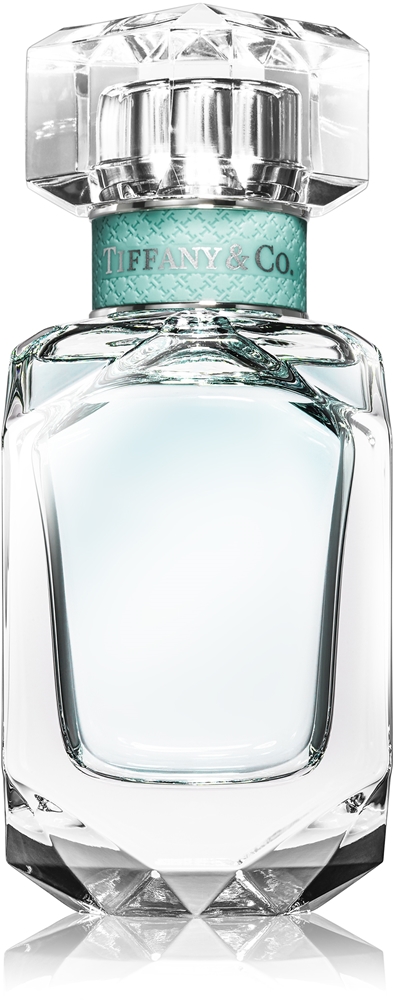
Within beauty, the brand's centerpiece is the 2017 Tiffany & Co. Eau de Parfum, created with Givaudan perfumer Daniela Roche-Andrier [5]. The composition is built around iris, with reported notes of mandarin orange, bergamot, lemon, rose, black currant, peach, patchouli and musk. Really Ree notes that the iris is a recurring motif in the company's history, tracing back to an iris brooch that won a grand prize at the 1900 Paris Exposition, and reports that the flower is prepared using a hydrodistillation method the company describes as unique to Tiffany [6]. The bottle draws on Tiffany diamond cuts and carries the signature blue collar and pattern. The Coty license has since extended the range with further releases, and the fragrances are sold both in Tiffany & Co. stores and through select luxury retailers.
Beyond perfume, the house is defined by objects such as the Tiffany Setting engagement ring, the Tiffany Blue Box and the Tiffany Yellow Diamond, which sit outside the beauty category but anchor the brand's identity.
Philosophy & positioning
The company frames love as the guiding idea behind its work, saying it has united "the jeweler's core values of inventiveness, craft and joy in designs that endure across generations" [1]. It positions itself at the top of the luxury market and, on its owner's account, as a pioneer in the art of fine jewelry.
Recognition
The 2017 Eau de Parfum drew notable commercial attention: CaFleureBon reported that it sold out within its first week before being restocked, and that Tiffany's share price rose around the launch [5]. In jewelry, the house's iris brooch won the grand prize at the 1900 Paris Exposition.
Current status
Tiffany & Co. is an active company. It is a maison within LVMH, ran more than 300 stores globally as of 2023, and maintains a multi-product fragrance line under its Coty license, with recent additions such as Rose Gold Intense (2023).
Facts & evidence
Documented facts from Glowpedia's fact base — every row carries a source.
Timeline#
Founded in New York as Tiffany, Young and Ellis (a 'fancy goods' store) by Charles Lewis Tiffany and John B. Young↗ en.wikipedia.org
Acquired the 278.42-carat rough yellow diamond later cut into the 128.54-carat Tiffany Diamond↗ sothebys.com
Introduced the Tiffany Setting six-prong solitaire engagement ring↗ sothebys.com
Louis Comfort Tiffany became first official design director↗ en.wikipedia.org
Acquired by Avon Products for $104 million↗ en.wikipedia.org
First 'Tiffany' fragrance for women launched; company returned to public markets↗ en.wikipedia.org
'Tiffany for Men' fragrance launched↗ en.wikipedia.org
'Tiffany Blue' color trademarked, later standardized with Pantone as '1837 Blue'↗ en.wikipedia.org
Tiffany & Co. and Coty Inc. announce new fragrance license agreement (Jan 27, 2016)↗ investors.coty.com
Launched the 'Tiffany & Co.' Eau de Parfum, its first major fragrance in almost fifteen years (perfumer Daniela Roche-Andrier, Givaudan)↗ cafleurebon.com
Acquired by LVMH for $15.8 billion; delisted from the NYSE↗ en.wikipedia.org
Acquired by LVMH Moët Hennessy Louis Vuitton for $15.8 billion↗ en.wikipedia.org
Awards#
Grand prize, Paris Exposition (iris brooch set with demantoid garnet blossoms and Montana sapphires) — jewelry↗ reallyree.com
Signature products#
The Company's first major fragrance release in almost fifteen years↗ cafleurebon.com
In 1886, Tiffany introduced the Tiffany Setting, a six-prong solitaire design that elevated the diamond above the band to maximize light exposure.↗ sothebys.com
Signature Items: The Tiffany Setting engagement ring design (conceived 1886); Tiffany Blue Box; Tiffany Yellow Diamond (128.54 carats)↗ en.wikipedia.org
A defining moment in Tiffany's history came in 1878 with the acquisition of a 278.42-carat rough yellow diamond, later cut into the 128.54-carat Tiffany Diamond.↗ sothebys.com
Tiffany & Co. Eau de Parfum (2017) — Sold out within the first week and was restocked; coverage noted Tiffany's share price rose around the launch↗ cafleurebon.com
Key ingredients#
Proprietary technologies & patents#
“The iris undergoes "a unique hydrodistillation extraction only used by Tiffany.”
Mentioned in#
Sotheby's — Editorial history: Charles Lewis Tiffany earned the title 'King of Diamonds,' establishing Tiffany as a leader in American luxury↗ sothebys.com
CaFleureBon — Review of the 2017 Tiffany & Co. Eau de Parfum, the brand's first major fragrance release in almost fifteen years↗ cafleurebon.com
Where to buy
Where the brand is sold according to Glowjakt's price data, per market.
Prices come from Glowjakt and are updated daily. Glowpedia receives no payment for clicks.
Ingredients across the range
Key ingredients across Tiffany & Co.'s range, from the ingredient lists of 23 of 24 products in Sweden.
Share of products with a known ingredient list. “None identified” means nothing matched our ingredient groups, not that the product is free of them.
Related brands


Sources
T1 primary · T2 secondary · T3 note- [1]T1lvmh.com/en/our-maisons/watches-jewelry/tiffany-colvmh.com (brand site)
- [2]T2investors.coty.com/news-events-and-presentations/news/news-details/2016/Tiffany--Co-and-Coty-Inc-Announce-New-Fragrance-Agreement/default.aspxinvestors.coty.com (brand site)
- [3]T3en.wikipedia.org/wiki/Tiffany_&_Co.Wikipedia
- [4]T3sothebys.com/en/articles/the-brilliant-history-of-tiffany-and-co-jewelrysothebys.com
- [5]T3cafleurebon.com/tiffany-co-perfume-review-daniela-roche-andrier-2017/cafleurebon.com
- [6]T3reallyree.com/tiffany-and-co-eau-de-parfum-2017-review/reallyree.com