Overview
Creed is a luxury perfume house that produces highly original artisan fragrances, the brand says, made from the finest natural ingredients. The company markets a long British lineage, presenting itself as "a different cut of Haute Perfumery, where British tailoring meets French savoir-faire." In practice the modern house operates from France, with its corporate headquarters in Paris and production near Fontainebleau, and its early history is contested. As of October 2025 Creed is a subsidiary of the French cosmetics group L'Oréal, having passed through private-equity and Kering ownership in the preceding years [5].
The brand is best known for men's fragrances, above all Aventus, and built its reputation during the rise of niche perfumery in the 2000s and 2010s. Its long-time creative figurehead, Olivier Creed, died on 22 May 2026; his son Erwin Creed continues to lead the house's creative direction [6].
Origin and founders
According to the company, Creed was founded in 1760 on Conduit Street in London by James Henry Creed, beginning as a tailoring house that dressed British royalty and the aristocracy before it evolved into a fragrance house [2]. Creed traces seven generations of family stewardship and "over 250 years" of continuous craft, framing the discipline of tailoring as the root of its later perfumery.
This early history is disputed. Wikipedia notes that the company was "supposedly" founded in 1760 but that the earliest evidence of its existence dates only to the late 1960s or early 1970s, and that no documents, warrants, receipts, vintage bottles or business licences predating 1970 are known to exist [5]. On this account, all pre-1970 history derives from Creed itself, and the verifiable modern fragrance house took shape around 1970 under Olivier Creed. The two versions sit side by side: the 1760 London founding is the brand's stated heritage, while the documented record begins much later in France.
History and milestones
Creed's own retellings emphasise a path from English tailoring to French perfumery. The house says Henry Creed received a Royal Warrant from Queen Victoria in 1885, the year he is said to have created a riding habit for the Queen [4]. The modern era is more firmly documented through its fragrances: Green Irish Tweed appeared in 1985 [5], and in 2010 the house launched Aventus, created by Olivier Creed with his son Erwin and inspired by the life of Napoleon Bonaparte. Aventus became a defining fragrance of what the trade press called the "masstige niche" era and has been described as one of the most commercially successful niche perfumes ever created [6].
Ownership
Creed remained family-controlled for much of its modern history before a rapid sequence of changes in ownership. In February 2020 the private-equity group BlackRock announced it would become Creed's majority shareholder [5]. In June 2023 the luxury group Kering acquired the house for 3.5 billion euros [5]. Then, in October 2025, Kering sold its beauty division, including Creed, to L'Oréal for 4 billion euros, placing the brand within L'Oréal's luxury portfolio alongside houses such as Lancôme, Kiehl's and Helena Rubinstein [5]. Some industry coverage published before the 2025 sale still describes Creed as a Kering brand, reflecting the ownership that held from 2023 to 2025.
Philosophy and positioning
Creed describes itself as an authentic, family-run house of haute perfumery, and positions its identity as British tailoring expressed through French perfumery technique. The company frames its values around exceptional materials, meticulous technique and what it calls a spirit of bespoke creation. Its fragrances sit at the luxury price tier and, by the brand's own account, are sold internationally through dedicated sites for markets including Australia, France, Germany, Spain, the United Kingdom and the United States, as well as a network of physical stockists.
Products and innovation
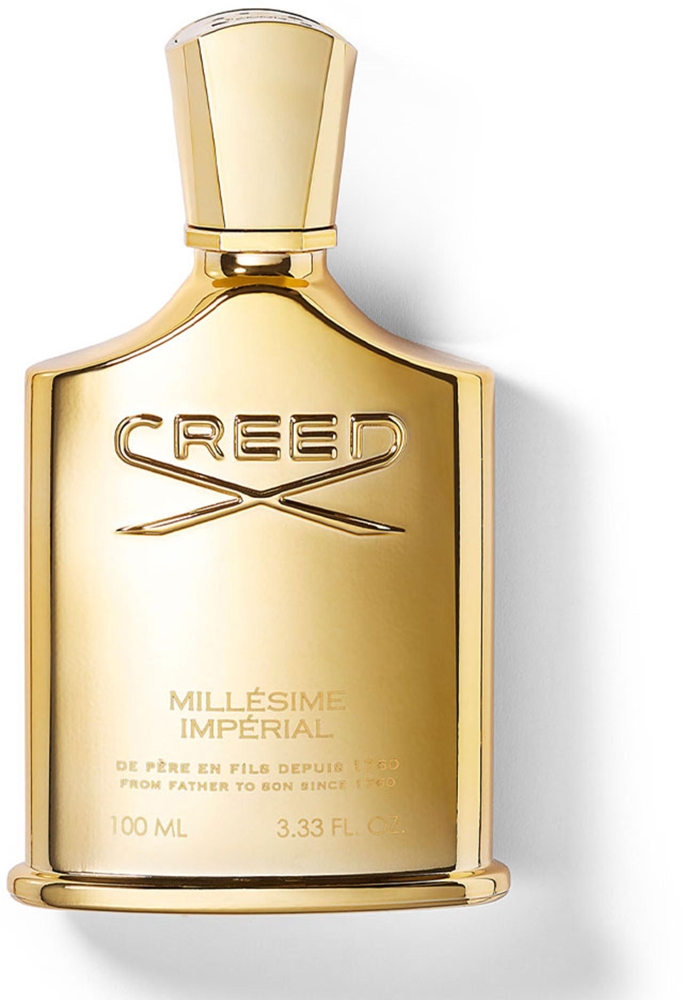
Fragrance is the house's sole core category. Alongside Aventus, its recognised scents include Green Irish Tweed (1985), Silver Mountain Water, Millesime Imperial and Original Vetiver. Creed centres its production on a method it calls the Art of Millésime, borrowing the term from wine to describe a fragrance tied to a particular vintage year and place. The company says its Millésime perfumes are blends of natural raw ingredients that are weighed, mixed and macerated largely by hand in a small artisanal factory near Fontainebleau, France.
The brand emphasises rare naturals high in essential oils, among them orris from Iris Pallida root, Bourbon vetiver, Calabrian bergamot, Bulgarian rose, Grasse jasmine, Sri Lankan sandalwood and Rose de Mai. According to the house, orris alone requires up to six years to prepare — roughly three years for the plant to mature and three more for harvesting and drying — before serving as an earthy, powdery fixative [3]. Because of their natural oil content, the company notes, each batch can vary subtly in scent from year to year, much as wine does.
Recognition
Creed's standing rests largely on Aventus, which the beauty-industry publication BeautyMatter cited as one of the most commercially successful niche perfumes ever made and a defining scent of the masstige niche era [6]. In its 2026 obituary of Olivier Creed, the same publication credited him with transforming the house from a relatively quiet luxury fragrance business into a global prestige name and described him as the sixth-generation figurehead of the Paris-based house [6].
Controversies
The authorship of several Creed fragrances has been questioned. Perfumer Pierre Bourdon has claimed to be the creator of scents credited to the Creed family, among them Green Irish Tweed — which he describes as an early iteration of Davidoff's Cool Water, also his work — along with Original Santal, Silver Mountain Water, Erolfa and Millesime Imperial [5].
Separately, the house's claimed heritage is itself contested. As noted above, historians and Wikipedia hold that no documentary evidence of the company exists before 1970, leaving its 1760 founding and pre-1970 history unverified and dependent on the brand's own telling [5].
Current status
Creed remains active and trading globally, with dedicated regional websites and a 2026 copyright on its site, and continues to release collections under its own name. Its corporate status changed through acquisition: it operates as a subsidiary within L'Oréal's luxury beauty division following the October 2025 sale. Creative direction continues under Erwin Creed after the death of Olivier Creed in May 2026.
Facts & evidence
Documented facts from Glowpedia's fact base — every row carries a source.
Timeline#
Brand claims founding as a tailoring house on Conduit Street, London, by James Henry Creed (disputed by historians; no documentary evidence pre-1970).↗ creedfragrance.com
Brand-claimed Royal Warrant from Queen Victoria; Henry Creed created a riding habit for Queen Victoria (per official Creed Boutique history page).↗ creedboutique.com
Green Irish Tweed launched.↗ en.wikipedia.org
Aventus launched (created by Olivier Creed with son Erwin); became a defining 'masstige niche' fragrance.↗ beautymatter.com
BlackRock announced it would become the majority shareholder of Creed.↗ en.wikipedia.org
Creed was acquired by Kering for €3.5 billion.↗ en.wikipedia.org
Kering sold its beauty division, including Creed, to L'Oréal for €4 billion.↗ en.wikipedia.org
Signature products#
Launched in 2010, Aventus became a defining fragrance of the 'masstige niche' era and is described as one of the most commercially successful niche perfumes ever created.↗ beautymatter.com
Green Irish Tweed (1985)↗ en.wikipedia.org
Pierre Bourdon claims to be the perfumer behind Green Irish Tweed ... Original Santal, Silver Mountain Water, Erolfa, Millesime Imperial among others.↗ en.wikipedia.org
Green Irish Tweed (1985); Aventus (2010); Silver Mountain Water; Millesime Imperial↗ en.wikipedia.org
Signature Fragrances Referenced: Aventus; Original Vetiver; Eladaria↗ creedfragrance.com
Aventus — Described as a defining fragrance of the 'masstige niche' era and one of the most commercially successful niche perfumes ever created.↗ beautymatter.com
Key ingredients#
Proprietary technologies & patents#
“Our Millésime perfumes are blends of high quality natural raw ingredients that are weighed, mixed and macerated, in most cases by hand, in a small artisanal factory near Fontainebleau, France.”
Mentioned in#
BeautyMatter — Obituary of Olivier Creed describing him as the perfumer widely credited with transforming Creed into one of the most commercially influential names in modern luxury perfumery; the sixth-generation figurehead of the Paris-based house.↗ beautymatter.com
Where to buy
Where the brand is sold according to Glowjakt's price data, per market.
Prices come from Glowjakt and are updated daily. Glowpedia receives no payment for clicks.
Ingredients across the range
Key ingredients across Creed's range, from the ingredient lists of 141 of 233 products in Sweden.
Share of products with a known ingredient list. “None identified” means nothing matched our ingredient groups, not that the product is free of them.
Related brands


Sources
T1 primary · T2 secondary · T3 note- [2]T1creedfragrance.com/c/about-us/creedfragrance.com (brand site)
- [3]T2creedfragrance.com/c/art-of-millesime/creedfragrance.com (brand site)
- [4]T2creedboutique.com/pages/the-history-of-creedcreedboutique.com (brand site)
- [5]T3en.wikipedia.org/wiki/Creed_(perfume_house)Wikipedia
- [6]T3beautymatter.com/articles/olivier-creed-dies-leaving-lasting-mark-on-modern-perfumerybeautymatter.com