Overview
Le Petit Marseillais is a French body-care and haircare brand founded in the early 1980s, built around the tradition of savon de Marseille (Marseille soap) and the imagery of Provence in the south of France. Its range covers shower gels, bar and liquid soaps, body and hand care, and shampoos sold mainly at drugstore prices. The brand is widely described by editorial sources as France's best-selling body-wash brand [11].
The company has been owned since 2022 by the American consumer-health group Kenvue, the business spun off from Johnson & Johnson, and trades in France as Kenvue France [9]. It remains active, with a website maintained into 2025 and distribution across Europe and, more recently, North America.
Origin & founders
The brand traces its beginnings to the journalist Bernard Lengellé. According to its own account, Lengellé was walking through a Provençal market in Avignon when a stall of cut soaps caught his attention; taking up the manufacturing methods of traditional Marseille soap, he created a vegetable-oil soap bar cut into small cubes and gave it scents and colours [1]. He named it after an older Provençal brand of the same name that had since disappeared, as a tribute to the region and to savon de Marseille. The logo, the company says, was inspired by his son looking out to sea from a pontoon in the port of Marseille.
Sources differ on exactly when the brand began. The company's heritage pages date the founding "pain végétal" — the vegetable soap bar — to 1980 [4], while elsewhere on the same site the brand repeatedly refers to its "creation in 1984" and to a first solid soap launched that year [5]. The French-language Wikipedia entry places the launch of the soaps in 1982 [9]. The brand's own materials are therefore internally inconsistent, with 1980 given as the originating idea and 1984 as the first solid soap.
History & milestones
Lengellé first sold his soap through pharmacies in the Vaucluse département. Accounts of the next step diverge: Wikipedia records that the brand was bought by Laboratoires Vendôme — a family parapharmaceutical company based in Dijon — in 1985 for 100,000 francs, then launched in French supermarkets in 1986 [9]; the brand's own history page compresses this, stating that it was acquired by Laboratoires Vendôme in 1986 [1]. Either way, the move into the grande distribution (mass-market retail) marked the point at which the brand took off.
The range widened over the following decades, expanding into shower products in the early 1990s and adding a shampoo line around 2000. By 2005, the brand was reported as the number-one name on the French cleansing-products market, with a 15.7% share [9]. Packaging milestones run alongside the product history: the company says it introduced its first eco-refills in 1992, cutting plastic by 73% compared with a pump bottle, and its first concentrated shower gels in 2019.
Ownership
Ownership has passed through several large companies. After the Vendôme acquisition, Laboratoires Vendôme was itself bought by Johnson & Johnson in 2006, bringing Le Petit Marseillais into the American group. In 2017, Johnson & Johnson sold Laboratoires Vendôme to Italy's Bolton Group but kept Le Petit Marseillais. When Johnson & Johnson spun off its consumer-health division as Kenvue, the brand moved to that new company, a transfer dated to 2022 [9]. It now sits within a Kenvue stable that includes Johnson's, Aveeno, Piz Buin, Clean & Clear and OGX.
Philosophy & positioning
Le Petit Marseillais positions itself around Provence and what it calls a "feel good" philosophy — taking pleasure in simple, sunlit everyday things and in nature-based ingredients meant to awaken the senses. The company sums up its outlook with the idea that "simple things are the best," and frames its ambition, in its own words, as making everyone happy. Its stated values centre on a joy of living, simplicity, authenticity and a Provençal, Mediterranean heritage.
The early honeysuckle soaps carried the slogan "être ou disparaître" ("to be or to disappear"), which the brand recalls as part of a pared-back design from its first years [1]. Throughout, the brand leans on the cultural standing of savon de Marseille, whose name has never been legally protected and whose traditional formula — 72% vegetable oils, with water, salt and soda — it presents as a benchmark of authenticity.
Products & innovation
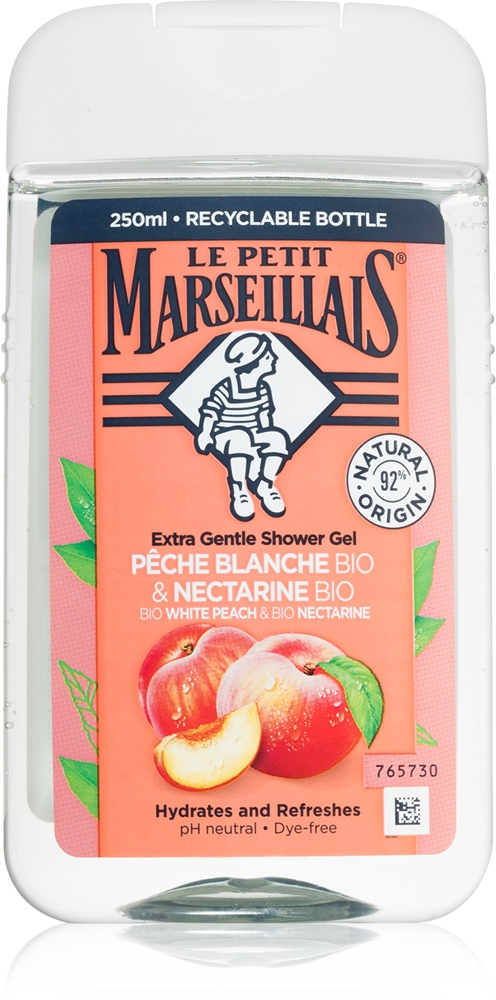
The brand's first product was a cube of Marseille soap, later sold as "l'Authentique," a 72% Extra Pur bar made to the traditional recipe. Its best-known lines are shower gels and shower crèmes; an editorial reviewer singled out the Orange Blossom Shower Crème as the brand's bestseller, alongside the White Peach & Nectarine Shower Gel [12]. More recently, the company highlighted the Crème au Lait moisturiser as its first multi-purpose body product.
Formulations draw on ingredients associated with Provence and the Mediterranean, among them olive oil, shea butter, sweet almond, argan oil, orange blossom, lavender and honey. The brand states that its products are pH-neutral and free of parabens, phthalates and salicylates. Manufacturing is spread across France, Italy and Greece [11].
Sustainability
Sustainability features prominently in the brand's own communications. It says it introduced refillable eco-packs as early as 1992 and has set a series of forward targets: that all of its rinse-off formulas should be highly biodegradable with at least 95% natural-origin ingredients, that all of its plant extracts should come from local, ethical or organic farming, and that all of its packaging should be recyclable, reusable or compostable, in line with the Ellen MacArthur Foundation charter [5]. The company also reports that 70% of its extracts are grown in France or the wider Mediterranean basin, and describes a conservation partnership with the Conservatoire du Littoral, the French coastal-protection body.
Recognition
As a mass-market brand, Le Petit Marseillais has drawn press coverage chiefly around its scale and its expansion beyond France. On its arrival in North America it was profiled by the fragrance site Fragrantica, which called it France's number-one selling body-wash brand, and reviewed by the beauty blog theNotice, which framed it as a long-standing French-pharmacy staple [12]. Both noted that enthusiasts had sought out the products before they were officially distributed in Canada.
Current status
The brand is active. Its website is maintained by Kenvue France and was last updated in 2025, and Kenvue has continued to feature the brand in its corporate communications, including work on refill-pack innovation. Kenvue describes the brand as having been "born over 40 years ago," consistent with its early-1980s origins, and it remains sold across multiple regions, with France as its core market.
Facts & evidence
Documented facts from Glowpedia's fact base — every row carries a source.
Timeline#
Bernard Lengellé creates a vegetable soap bar (pain végétal) inspired by a Provençal market in Avignon — origin of the brand.↗ lepetitmarseillais.com
Le Petit Marseillais soaps launched by Bernard Lengellé (per Wikipedia); logo created 1982 by graphic designer Christian Bernard in Carpentras.↗ fr.wikipedia.org
First solid soap; brand-stated 'creation' year and start of sustainability commitments.↗ lepetitmarseillais.com
Brand acquired by Laboratoires Vendôme for 100,000 francs (family parapharmaceutical company, Dijon).↗ fr.wikipedia.org
Acquired by Laboratoires Vendôme for 100,000 francs.↗ fr.wikipedia.org
Launched in French supermarkets (grande distribution); brand 'takes off'.↗ lepetitmarseillais.com
First eco-refills (éco-recharges), -73% plastic vs pump bottle.↗ lepetitmarseillais.com
Shampoo line introduced (after expanding into shower products in the early 1990s).↗ fr.wikipedia.org
Number-one brand on the French cleansing-products market with 15.7% market share.↗ fr.wikipedia.org
Laboratoires Vendôme acquired by Johnson & Johnson; Le Petit Marseillais passes to J&J.↗ fr.wikipedia.org
J&J sells Laboratoires Vendôme to Italy's Bolton Group but retains Le Petit Marseillais.↗ fr.wikipedia.org
First concentrated shower gels, -60% plastic vs a 400ml bottle.↗ lepetitmarseillais.com
Ownership transferred to Kenvue (J&J consumer-health spin-off).↗ fr.wikipedia.org
Signature products#
c’est tout naturellement que Le Petit Marseillais vous offre depuis 10 ans son cube de savon de Marseille 72% Extra Pur […] nous l’avons appelé tout simplement « l’Authentique ».↗ lepetitmarseillais.com
My favourites are the Orange Blossom Shower Crème (the brand’s bestseller) and the White Peach & Nectarine Shower Gel↗ thenotice.net
Redécouvrez la gamme de gels douche iconique↗ lepetitmarseillais.com
I’ve been especially proud to work on the launch of our first-ever multi-purpose product, the Crème au Lait moisturizer.↗ kenvue.com
Le Petit Marseillais body wash / shower gels (France's #1 body wash brand) — Repeatedly cited by editorial sources as France's #1 selling body wash brand; beauty enthusiasts reportedly 'smuggled' bottles into Canada before official distribution.↗ fragrantica.com
Key ingredients#
Mentioned in#
Fragrantica — Feature 'Le Petit Marseillais: France's #1 Selling Body Wash Brand' reviewing the brand's bath & body range on its North American arrival.↗ fragrantica.com
theNotice — Review framing Le Petit Marseillais as a French-pharmacy favourite and #1 best-selling body wash in France, now available in Canada/US.↗ thenotice.net
Certification pass
What each certification and self-stated claim rests on: the source, whose website it's on, and what needs review.
“Nos formules plus naturelles, biodégradables et certifiées BIO […] Certifiées BIO”↗ lepetitmarseillais.com
ethics_and_sustainability.certifications
“100% de nos innovations en 2020 contiennent des extraits issus de l’agriculture biologique”↗ lepetitmarseillais.com
“100% de nos emballages seront recyclables, réutilisables ou compostables, conformément à notre engagement pour la charte Ellen Mac Arthur.”↗ lepetitmarseillais.com
“1992 : 1ères éco-recharges, permettant une réduction de -73% de plastique par rapport au flacon pompe”↗ lepetitmarseillais.com
“Le Petit Marseillais products are pH neutral; paraben-, phthalate- and salicylate-free”↗ fragrantica.com
None of these statements has been checked against the certifying bodies' registers. The statements were observed on 16 Jun 2026.
Where to buy
Where the brand is sold according to Glowjakt's price data, per market.
Prices come from Glowjakt and are updated daily. Glowpedia receives no payment for clicks.
Ingredients across the range
Key ingredients across Le Petit Marseillais's range, from the ingredient lists of 25 of 27 products in Sweden.
Share of products with a known ingredient list. “None identified” means nothing matched our ingredient groups, not that the product is free of them.
Related brands
Sources
T1 primary · T2 secondary · T3 note- [1]T1lepetitmarseillais.com/coucou-la-marque/notre-histoirelepetitmarseillais.com (brand site)
- [4]T2lepetitmarseillais.com/coucou-la-marque/sous-le-soleil-de-provencelepetitmarseillais.com (brand site)
- [5]T2lepetitmarseillais.com/coucou-la-marque/nos-engagementslepetitmarseillais.com (brand site)
- [9]T3fr.wikipedia.org/wiki/Le_Petit_Marseillais_(savon)Wikipedia
- [11]T3fragrantica.com/news/Le-Petit-Marseillais-France-s-1-Selling-Body-Wash-Brand-9435.htmlfragrantica.com
- [12]T3thenotice.net/2017/08/le-petit-marseillais-review/thenotice.net