
Overview
Neoretin is a Spanish dermocosmetic skincare line specialising in the treatment of dark spots and uneven skin tone. It is owned by Cantabria Labs, a dermatological pharmaceutical company based in Madrid, and sits alongside sister brands such as Heliocare, Endocare and Biretix within that company's portfolio. Neoretin's products are sold through pharmacies and dermocosmetic channels, and the company positions the line as what it calls "the leading depigmenting brand in medical prescriptions" [1].
The brand is built around patented retinoid and depigmenting technology and is supported by a comparatively unusual body of independent clinical evidence: three peer-reviewed trials published between 2014 and 2023 evaluated its core products in different populations. The line remains active, with a new serum added to its range in 2026 [1].
Ownership
Neoretin is a sub-brand of Cantabria Labs, which traces its corporate origins to Industrial Farmacéutica Cantabria (IFC). Cantabria Labs acquired a full stake in IFC in 1994 and operated under the IFC name until 2018, when it was renamed Cantabria Labs [3]. The company is headquartered in Madrid and runs research and production facilities in Santander and Madrid.
Cantabria Labs describes itself as a leading brand in dermatological prescriptions in Europe, citing market-leadership positions in Spain, Italy and Portugal. It operates direct subsidiaries in several countries, including Italy, France, Portugal, Mexico, Morocco, China and the United States, and says its products reach more than 85 countries through wider distribution alliances [8]. Neoretin shares this portfolio with brands covering adjacent dermatological needs — Heliocare for sun protection, Endocare for ageing skin, and Biretix for acne-prone skin, among others. The wider group also has a research history beyond skincare actives, including early work on oral sunscreens with Harvard University in the 1990s and a research alliance signed with MIT in 2017.
The Neoretin line grew directly out of the parent company's technology acquisitions. In 2006 Cantabria Labs acquired the patent for RetinSphere, a retinoid technology that became foundational not only for Neoretin but also for the Endocare and Biretix ranges [3]. In 2011 the company purchased rights to further technologies addressing hyperpigmentation alongside hair loss, acne and photoageing — a step that plausibly consolidated the depigmenting active stack the Neoretin line is built on [3]. No source publishes an explicit launch year for the line itself, but the first peer-reviewed trial of its products appeared in 2014, indicating that Neoretin was on the market by 2013 at the latest.
Philosophy and positioning
Neoretin is positioned around clinical proof rather than lifestyle appeal, consistent with the wider Cantabria Labs approach. The company stakes the line's identity on dermatologist endorsement and what it describes as "an innovative combination of patented actives with potent depigmenting action" aimed at the underlying causes of dark spots. Its scientific advisor states that the products are supported by clinical studies demonstrating efficacy and tolerability, and the parent company frames its broader mission around developing solutions for current and future skin problems in collaboration with healthcare professionals.
The line is aimed at adults dealing with melasma, post-inflammatory hyperpigmentation and sun-damage spots, and is marketed as suitable for sensitive skin prone to dark spots. Its global tagline is "Depigmenting power and effectiveness for skin with no dark spots"; in the United Kingdom market the brand is presented under the phrase "Advanced pigment control".
Products and innovation
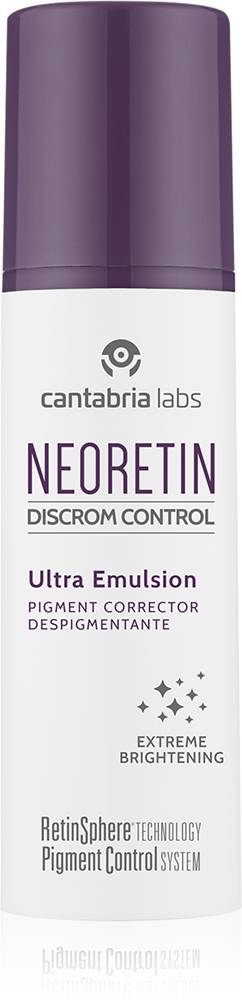
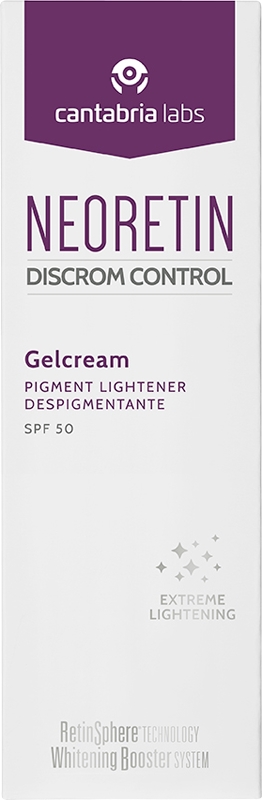
Neoretin's products fall under a single sub-line, Discrom Control, which spans a microexfoliating cleanser, several serums, an eye contour cream, an SPF 50 day cream, a transition cream, peel pads and a body lotion for sensitive areas. Among the range, the company highlights the Pigment Neutralizer Serum, the Concentrate Serum and the Ultra Emulsion as core depigmenting treatments. The Pigment Neutralizer Serum is formulated for skin that cannot tolerate retinol or AHAs, combining azelaic acid, bakuchiol and hyaluronic acid, and is intended for year-round day and night use.
The line draws on several proprietary technologies developed or acquired by Cantabria Labs. RetinSphere, the system at its centre, combines two high-tolerance retinoids in a dual-delivery format designed to provide both sustained and immediate release, with the stated aim of encouraging skin renewal while limiting irritation. Azelaic AOX-TECH is a delivery system that, according to the company, increases the action of azelaic acid up to five times for better penetration [10]. A further patented technology, Edafence, an anti-pollution system the parent company patented in 2017, is also used in the Neoretin and Endocare ranges [5]. The brand additionally describes a "Pigment Control System" combining six active ingredients — including tranexamic acid, niacinamide, hexylresorcinol and N-acetylglucosamine — intended to act at multiple stages of melanin formation. The published ingredient list for the Concentrate Serum also includes glycolic acid and the high-tolerance retinoid ester hydroxypinacolone retinoate alongside retinol [13].
What distinguishes Neoretin within the dermocosmetic category is the depth of its published clinical testing. The foundational study, by Truchuelo and colleagues, was published in the Journal of Cosmetic Dermatology in 2014; conducted at the University Hospital Ramón y Cajal in Madrid, the double-blind, vehicle-controlled split-face trial in 30 women reported a 70 percent improvement in melasma severity on the treated side, which the authors described as comparable to the improvement reported with hydroquinone, a long-established depigmenting agent. The study reported no notable side effects, despite many participants having a history of sensitive skin [14]. A 2016 study by García-Millán and colleagues extended testing to 30 patients of Mexican origin aged 34 to 78, reporting improvement in more than 65 percent of cases using a serum-and-SPF regimen, and described the combination as well tolerated [15]. A third trial, published by Le Huu and colleagues in the Vietnamese Journal of Dermatology and Venereology in 2023, reported a 64 percent reduction in melasma severity and a 30 percent reduction in a melanin measurement among 36 patients over four months; the most common side effect was a mild-to-moderate stinging sensation, reported by about half of participants, with no serious or systemic effects [16]. Taken together, the three studies span lighter, Latin American and East Asian skin types. Cantabria Labs separately states that its own testing showed a 48 percent reduction in the intensity and size of dark spots following the Neoretin protocol [1].
Sustainability
Neoretin does not publish product-level sustainability claims, certifications or vegan or cruelty-free badges. At parent-company level, Cantabria Labs operates a production centre at La Concha in Cantabria, inaugurated in 2019, which it describes as eco-sustainable and which draws on geothermal energy from a local thermal spring [7]. The company has not published specific third-party environmental certifications or quantified targets, and its environmental statements remain largely qualitative.
Current status
Neoretin is an active line. Its most recent visible development is the 2026 addition of a Concentrate Serum to the Discrom Control range, marked as new on the official Cantabria Labs site [1].
Facts & evidence
Documented facts from Glowpedia's fact base — every row carries a source.
Timeline#
Cantabria Labs acquires RetinSphere patent — foundational depigmenting+epidermal-renewal technology for the Neoretin line (also Endocare and Biretix)↗ cantabrialabs.com
Cantabria Labs purchases rights to additional technologies for hyperpigmentation (alongside hair loss, acne, photoaging) — likely consolidating Neoretin's six-active Whitening Booster stack↗ cantabrialabs.com
Foundational peer-reviewed clinical trial published: Truchuelo et al., Journal of Cosmetic Dermatology (PMID 25399618). 70% MASI improvement comparable to hydroquinone in 30 Caucasian women↗ pubmed.ncbi.nlm.nih.gov
García-Millán et al. clinical study extends efficacy to Latin American (Mexican) population, >65% improvement↗ regenesis.co.id
Cantabria Labs patents Edafence anti-pollution technology now used in the Neoretin (and Endocare) ranges↗ cantabrialabs.com
Le Huu et al. (Vietnamese Journal of Dermatology & Venereology) confirms 64% MASI reduction in Vietnamese melasma patients — completing cross-ethnic clinical evidence base↗ vjdv.vn
New 'Concentrate Serum' added to NEORETIN Discrom Control range (marked NEW on official Cantabria Labs site)↗ cantabrialabs.com
Signature products#
Dark spot corrector and even skin tone serum for more radiant skin↗ cantabrialabs.com
Targets resistant hyperpigmentation↗ cantabrialabs.com
Intensive depigmenting solution↗ cantabrialabs.com
Depigmenting anti-dark circles eye contour cream↗ cantabrialabs.com
SPF Depigmenting day cream↗ cantabrialabs.com
Depigmenting serum↗ cantabrialabs.com
Intensive depigmenting facial pads↗ cantabrialabs.com
Key ingredients#
Proprietary technologies & patents#
“RetinSphere Technology - An innovative technology that combines two high-tolerance retinoids that stimulate epidermal renewal. It reduces dark spots and promotes an even skin tone.”
“2006 | acquired the patent for RetinSphere used across Endocare, Biretix, and Neoretin ranges; 2017 | patented Edafence, an anti-pollution technology”
Mentioned in#
Journal of Cosmetic Dermatology (Wiley) — Peer-reviewed clinical trial of Neoretin Discrom Control by Truchuelo, Jiménez and Jaén at University Hospital Ramón y Cajal Madrid, demonstrating 70% MASI improvement comparable to hydroquinone↗ pubmed.ncbi.nlm.nih.gov
Journal of Dermatological and Clinical Research — García-Millán et al. published evaluation of Neoretin Discrom Control regimen in 30 Mexican-origin melasma patients↗ regenesis.co.id
Vietnamese Journal of Dermatology & Venereology (VJDV) — Le Huu et al. published efficacy and tolerability study of Neoretin Discrom Control Serum in 36 Vietnamese melasma patients (64% MASI reduction)↗ vjdv.vn
Where to buy
Where the brand is sold according to Glowjakt's price data, per market.
Prices come from Glowjakt and are updated daily. Glowpedia receives no payment for clicks.
Ingredients across the range
Key ingredients across Neoretin's range, from the ingredient lists of 5 of 5 products in Sweden.
Share of products with a known ingredient list. “None identified” means nothing matched our ingredient groups, not that the product is free of them.
Related brands


Sources
T1 primary · T2 secondary · T3 note- [1]T1cantabrialabs.com/our-brands/neoretin/cantabrialabs.com (brand site)
- [3]T1cantabrialabs.com/about-us/history/cantabrialabs.com (brand site)
- [5]T1cantabrialabs.com/about-us/rd/cantabrialabs.com (brand site)
- [7]T1cantabrialabs.com/about-us/environmental-commitment/cantabrialabs.com (brand site)
- [8]T1cantabrialabs.com/about-us/international-presence/cantabrialabs.com (brand site)
- [10]T1cantabrialabs.co.uk/pages/range/neoretincantabrialabs.co.uk (brand site)
- [13]T3incidecoder.com/products/neoretin-discrom-control-concentrateincidecoder.com
- [14]T3pubmed.ncbi.nlm.nih.gov/25399618/pubmed.ncbi.nlm.nih.gov
- [15]T3regenesis.co.id/wp-content/uploads/2024/04/NDC_-2016_C-Garcia-Millan_J-Dermatol-Clin-Res_EN-1-1.pdfregenesis.co.id
- [16]T3vjdv.vn/index.php/vjdv/article/download/68/50/60vjdv.vn