Overview
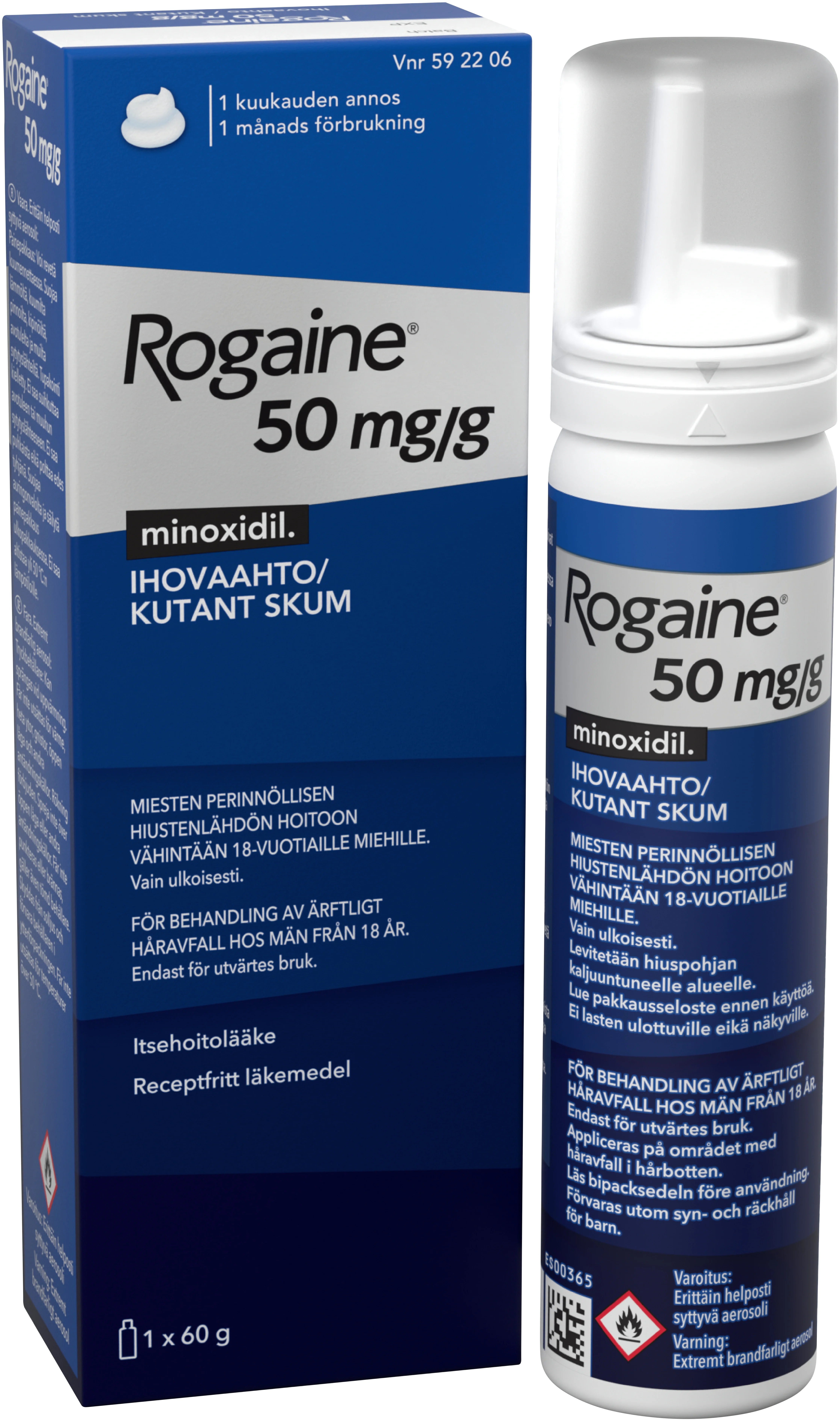
Rogaine is a topical hair-regrowth brand built on the drug minoxidil, sold in the United States as Rogaine and in many other markets as Regaine. It was the first topical treatment approved by the U.S. Food and Drug Administration (FDA) to regrow hair, initially for men and later for women. The brand is currently owned by Kenvue Inc., the consumer-health company spun off from Johnson & Johnson in May 2023 [3].
The founding year is best placed at 1988, when the FDA approved the Rogaine brand and the product launched; the underlying minoxidil compound, however, was synthesized decades earlier, in 1963 [2]. The brand remains actively marketed, with a product line that spans topical solutions and foam for both men and women.
Origin and discovery
Rogaine traces back to a laboratory accident. Minoxidil was first developed by the Upjohn Company and used to treat high blood pressure, taken as a tablet marketed under the name Loniten [2]. Patients on the drug began growing unwanted hair, an unexpected side effect that prompted Upjohn to investigate whether it could be turned into a treatment for hair loss. The company frames this as serendipity: according to Rogaine, "the power of minoxidil to regrow hair came about by chance," a discovery it dates to scientists working in the 1980s.
The hair-growth effect was documented by researchers outside the company as well. Charles A. Chidsey at the University of Colorado School of Medicine ran early studies, the second of which showed unexpected hair growth, while Guinter Kahn, a dermatology resident at the University of Miami, was among the first to report hair development in patients using minoxidil. That work eventually led to a topical solution applied directly to the scalp.
History and milestones
Upjohn synthesized minoxidil in 1963, and the FDA approved it as an oral tablet for high blood pressure in 1979. Its use for hair loss followed nearly a decade later. In August 1988 the FDA approved Rogaine 2% topical solution for male baldness, making it the first hair-loss treatment drug cleared in the United States; the agency had rejected the proposed name "Regain" as misleading [2]. A version for women became available in 1991.
The brand's reach widened through the 1990s. In February 1996 the FDA approved over-the-counter sale and generic formulations, moving Rogaine from prescription to the drugstore shelf [2]. A 5% formulation was cleared for nonprescription sale in 1998, and in 2006 a 5% aerosol foam was approved. In 2023 the brand marked its 35th anniversary, counting from the 1988 approval, in a campaign tied to National Hair Loss Awareness Month [7].
Ownership
Rogaine has passed through several corporate hands. Upjohn, its original developer, later became part of Pfizer [2]. The brand was subsequently marketed by Johnson & Johnson; men's Rogaine went off-patent on January 20, 2006, and the women's version off-patent in February 2014 [2]. When Kenvue Inc. was launched as a standalone public company in May 2023 through a spin-off from Johnson & Johnson, Rogaine became part of Kenvue's portfolio [3]. It sits alongside sister brands including Aveeno, Clean & Clear, Piz Buin and OGX.
Products and positioning
The brand's line centers on a single active ingredient, minoxidil, offered in 2% and 5% strengths as both a topical solution and a foam. The original 1988 men's product was a 2% solution; the 5% aerosol foam followed in 2006, and a dedicated women's solution arrived in 1991. Rogaine positions itself as the first FDA-approved topical option for regrowing hair in both men and women, and the company describes it as "the industry-leading, #1 dermatologist recommended brand for hair regrowth" [1]. It is sold over the counter through drugstores and pharmacies.
Independent medical sources describe how the treatment works and its limits. Minoxidil increases hair counts and thickens individual follicles but "does not appear to slow or prevent hair loss" and requires indefinite use to maintain results [2]. The Cleveland Clinic notes that the drug treats hereditary hair loss and that regrown hair "will usually fall out within 3 months" once treatment stops [4]. Dermatology sources add that minoxidil shortens the resting (telogen) phase of the hair cycle to promote new growth and increases blood flow to the scalp [6].
Current status
Rogaine remains an active, globally distributed brand under Kenvue, sold as Rogaine in the United States and as Regaine in other markets, with a current lineup of foam and solution products for men and women. Its most recent notable brand activity was the 2023 anniversary campaign [7].
Facts & evidence
Documented facts from Glowpedia's fact base — every row carries a source.
Timeline#
Upjohn Company develops minoxidil (originally a vasodilator)↗ en.wikipedia.org
FDA approves oral minoxidil tablets (brand name Loniten) for high blood pressure↗ en.wikipedia.org
FDA approves Rogaine 2% topical solution for male baldness — first hair-loss treatment drug in the US (Aug 17, 1988)↗ en.wikipedia.org
Rogaine becomes available for women↗ en.wikipedia.org
FDA approves over-the-counter (OTC) sale and generic formulations (February 1996)↗ en.wikipedia.org
5% formulation approved for nonprescription sale↗ en.wikipedia.org
5% aerosol foam formula approved for medical use in the US; men's Rogaine goes off-patent↗ en.wikipedia.org
Brand marketed by Johnson & Johnson (J&J consumer health)↗ en.wikipedia.org
Kenvue Inc. spun off from Johnson & Johnson as standalone public company (May 2023); Rogaine becomes part of Kenvue's portfolio↗ en.wikipedia.org
Signature products#
FDA approved Rogaine 2 percent topical solution as the first hair loss treatment drug in the United States on August 17, 1988.↗ en.wikipedia.org
2006: 5% aerosol foam formula approved for medical use in the US↗ en.wikipedia.org
1991: Product became available for women↗ en.wikipedia.org
Rogaine (minoxidil) — Widely regarded as the original / first FDA-approved consumer hair-regrowth treatment and the genericized reference brand for topical minoxidil↗ my.clevelandclinic.org
Key ingredients#
Proprietary technologies & patents#
“That started the years of product innovations leading to the multi-generation ROGAINE® prod[ucts].”
“Men's Rogaine was "marketed by Johnson & Johnson" and "went off-patent on January 20, 2006." Women's Rogaine also "marketed by Johnson & Johnson, went off-patent in February 2014.”
Mentioned in#
Happi — Reported Rogaine's 35th anniversary during National Hair Loss Awareness Month↗ happi.com
Where to buy
Where the brand is sold according to Glowjakt's price data, per market.
| Market | products | in stock | stores | Price range |
|---|---|---|---|---|
| Sweden | 2 | 1 | 3 | 223.20 SEK – 599 SEK |
Prices come from Glowjakt and are updated daily. Glowpedia receives no payment for clicks.
Related brands


Sources
T1 primary · T2 secondary · T3 note- [1]T1rogaine.com/pages/our-storyrogaine.com (brand site)
- [2]T3en.wikipedia.org/wiki/MinoxidilWikipedia
- [3]T3en.wikipedia.org/wiki/KenvueWikipedia
- [4]T3my.clevelandclinic.org/health/drugs/18238-minoxidil-topical-solution-or-foammy.clevelandclinic.org
- [6]T3michelegreenmd.com/topical-minoxidil-for-hair-lossmichelegreenmd.com
- [7]T3happi.com/breaking-news/rogaine-celebrates-35th-anniversary-for-national-h/happi.com